AI insights
Article by
Mindrift Team

Every year, PwC sifts through a mountain of job ads to answer one question: what is AI actually doing to work? This year, the mountain had more than a billion ads from six continents.
The result is the 2026 Global AI Jobs Barometer, written for CEOs and HR leaders figuring out how to reshape their workforce. It covers wage premiums, graduate programs and productivity growth. It doesn’t mention AI trainers once.
But read between the lines, and the report keeps describing what AI trainers do. It talks about judgement and catching what’s wrong. It talks about explaining why, and about being the person whose call can be trusted.
So we did what we did with McKinsey’s tech trends report: we went to the fine print and turned the lens on the humans behind the technology. Here’s what we found.
Short on time? Here’s the quick version:
AI is splitting jobs into two tracks. The track that rewards expert judgement is pulling ahead on pay and job growth.
The human skills gaining value are the ones AI training runs on: judgement, creativity and empathy.
Entry-level jobs now ask for senior-level skills and AI training is a great place to practice them.
AI isn’t replacing jobs, it’s splitting them into two tracks
If you’ve been bracing for the “robots take all the jobs” headline, this report has a twist. Even in roles highly exposed to AI, job numbers and wages are still rising. PwC’s explanation is that what matters isn’t how much of your job AI can do, it’s which parts it takes over. PwC breaks jobs down into two tracks:
Professionalized jobs: AI handles the routine work, leaving humans with the expert stuff. For example, a legal model summarizes documents while the lawyer builds the actual case.
Democratized jobs: AI takes on the expert tasks and the human side gets less specialized. Inventory clerks are PwC’s example: AI manages the inventory while people move the stock. Accounting clerks and software developers are on this track too.
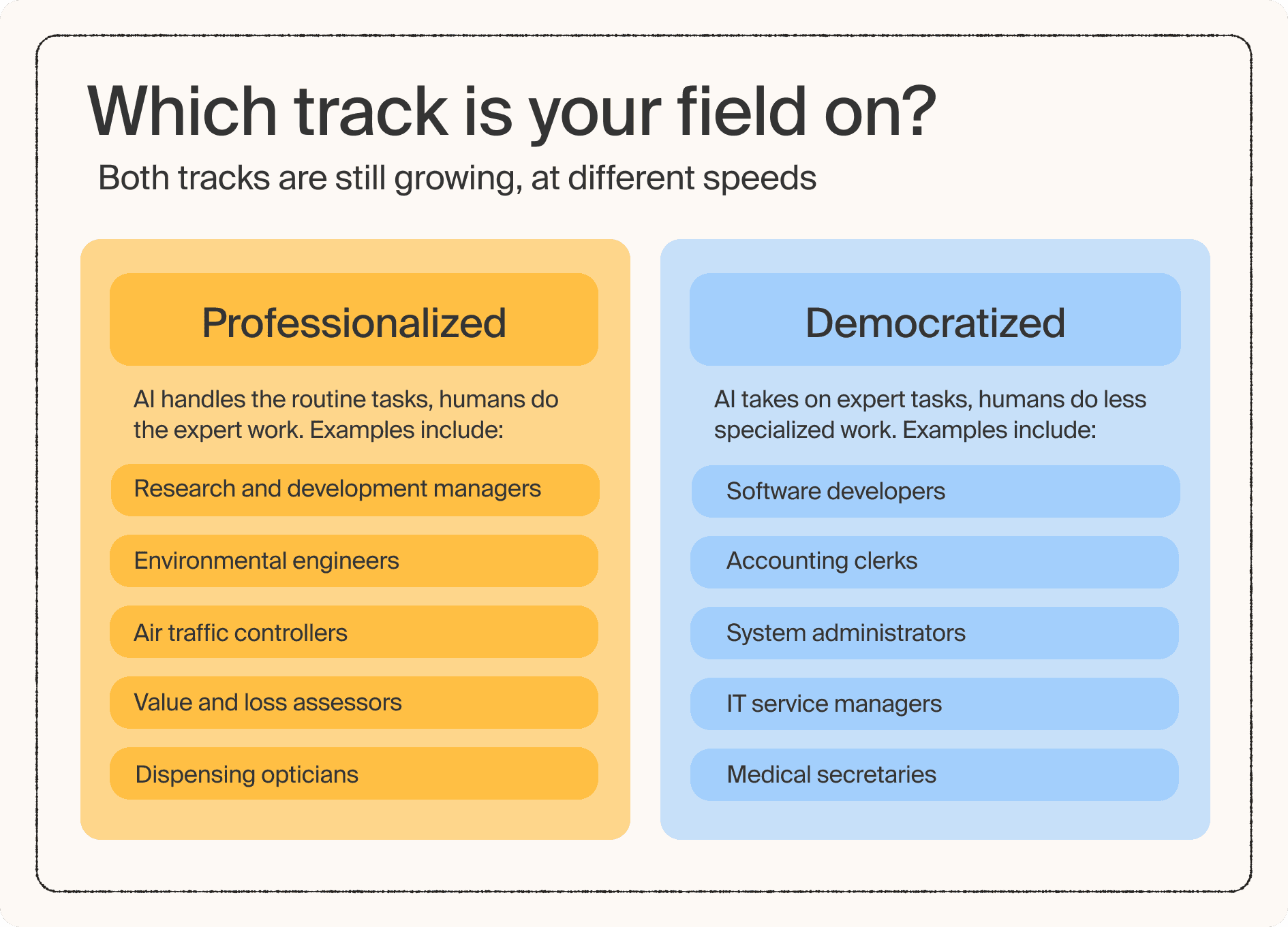
So who’s pulling ahead? Since 2021, Professionalized roles have seen:
42% faster salary growth than Democratized roles
Job ads growing about twice as fast
New skills being added twice as fast, as employers expect more from these roles
And the gap has been widening since AI adoption took off. Why? Trust. “AI is not devaluing expertise; it is concentrating value around trusted expertise,” said Peter Wheeler, Managing Director, Workforce & Change, PwC Australia.
As AI does more of the doing, employers value people who can make judgment calls, work through gray areas and stand behind their decisions. Sound familiar? That’s a big part of AI training: looking at a polished, confident AI answer, deciding whether it holds up, and explaining why.
What this means for AI trainers
Your superpower is spotting what’s wrong: AI is great at producing answers that sound right. The expert skill is catching the ones that aren’t: the flaw in the legal reasoning, the edge case the code misses, the medical claim that’s almost accurate.
Go deep, not wide: Ten years in accounting, nursing or structural engineering is worth more here than knowing every AI tool on the market. Specialized models need specialized experts.
Show your work: A rating without reasoning is just a number. Your written explanation is what turns your judgement into something people can trust and models can learn from.
The skills AI made more valuable
The jobs AI touches most are also changing the fastest. In Australia, the most AI-exposed occupations added an average of 187 new skills per role over the last six years. That’s about double the 93 added in the least exposed jobs. Globally, the pattern repeats: skills in the most AI-exposed roles are changing more than twice as fast.
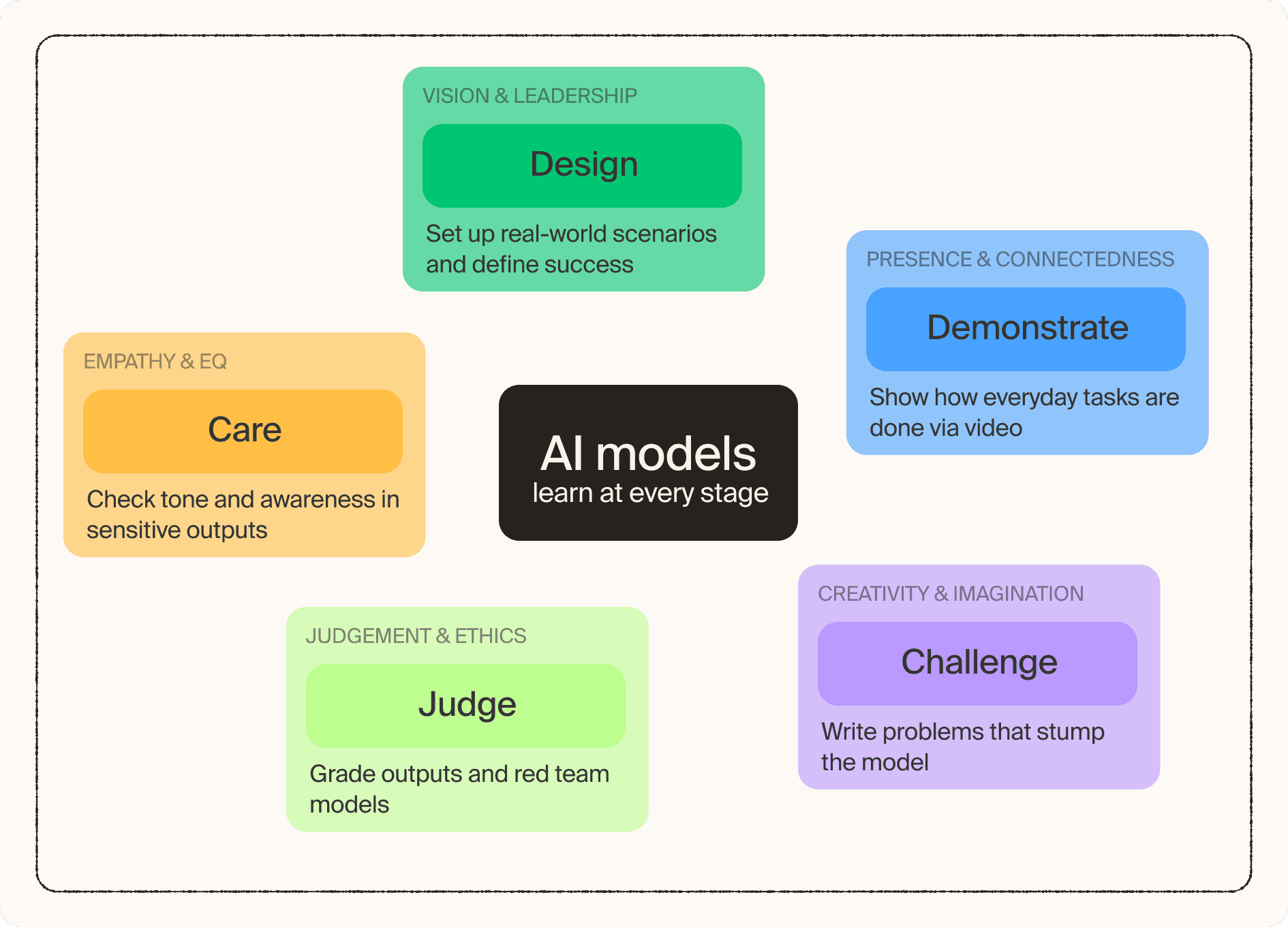
So which skills are rising? To find out, PwC used MIT’s EPOCH framework, which maps the human abilities AI still struggles to replicate. New tasks being added to AI-exposed jobs are 2.5x more likely to need these abilities.
Judgement, opinion, and ethics
AI can weigh options, but it can’t take responsibility for a decision. That still requires a human who understands the context, the stakes, and the gray areas in between.
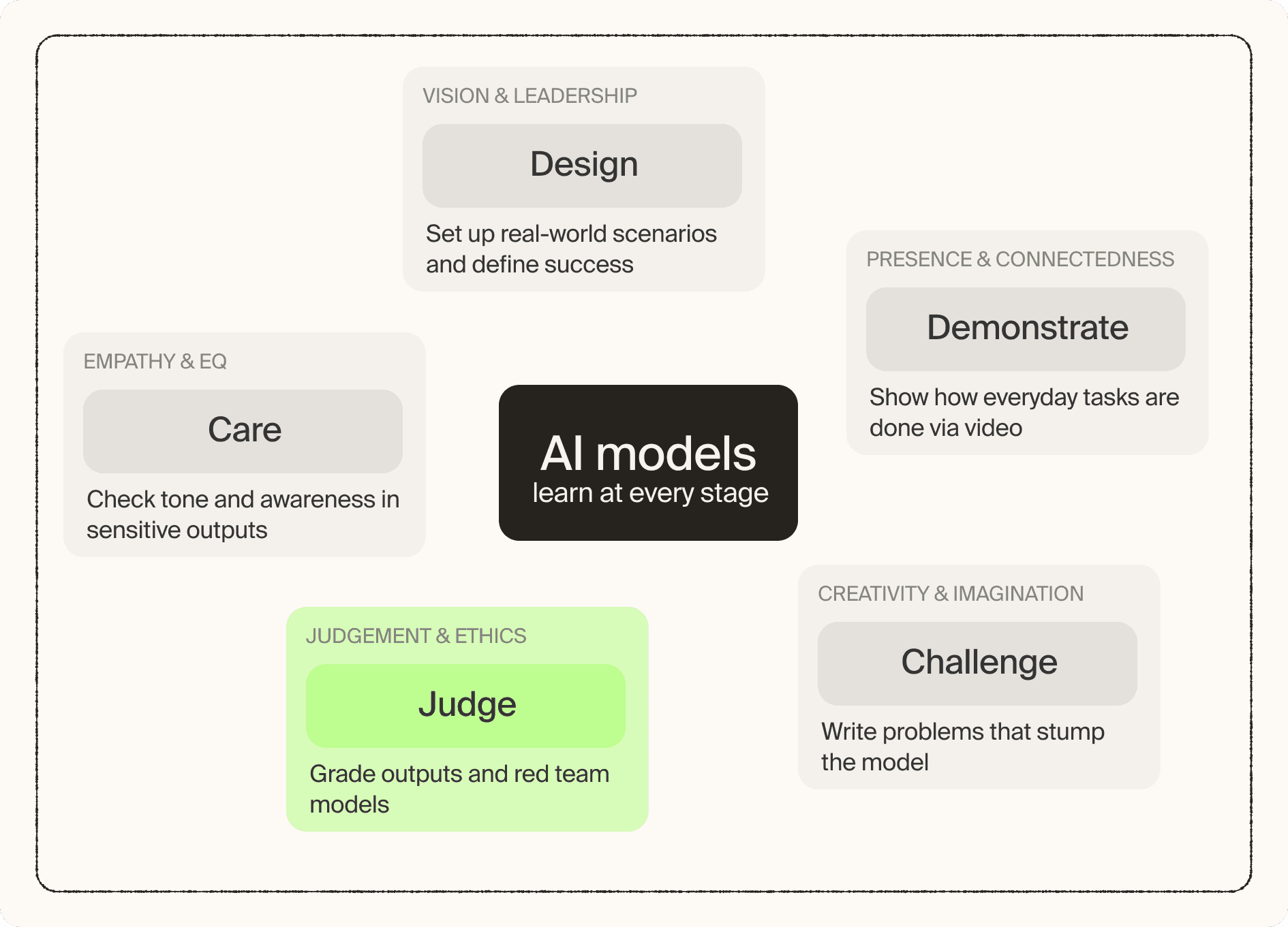
This is also the backbone of many AI projects. A contributor might grade AI answers against a detailed rubric, decide which of two responses is more accurate or helpful, or red-team a model to deliberately try to get it to say something unsafe, biased or wrong so developers can fix it.
How to build it:
Practice explaining why an answer is wrong, not just that it is.
Read your field’s ethics guidelines or codes of conduct, and notice where they leave room for interpretation. Those gray areas are exactly where AI needs human input.
Creativity and imagination
Some say AI is great at remixing what already exists. But is it just as good at coming up with something genuinely new or anticipating weird situations real life throws at us?
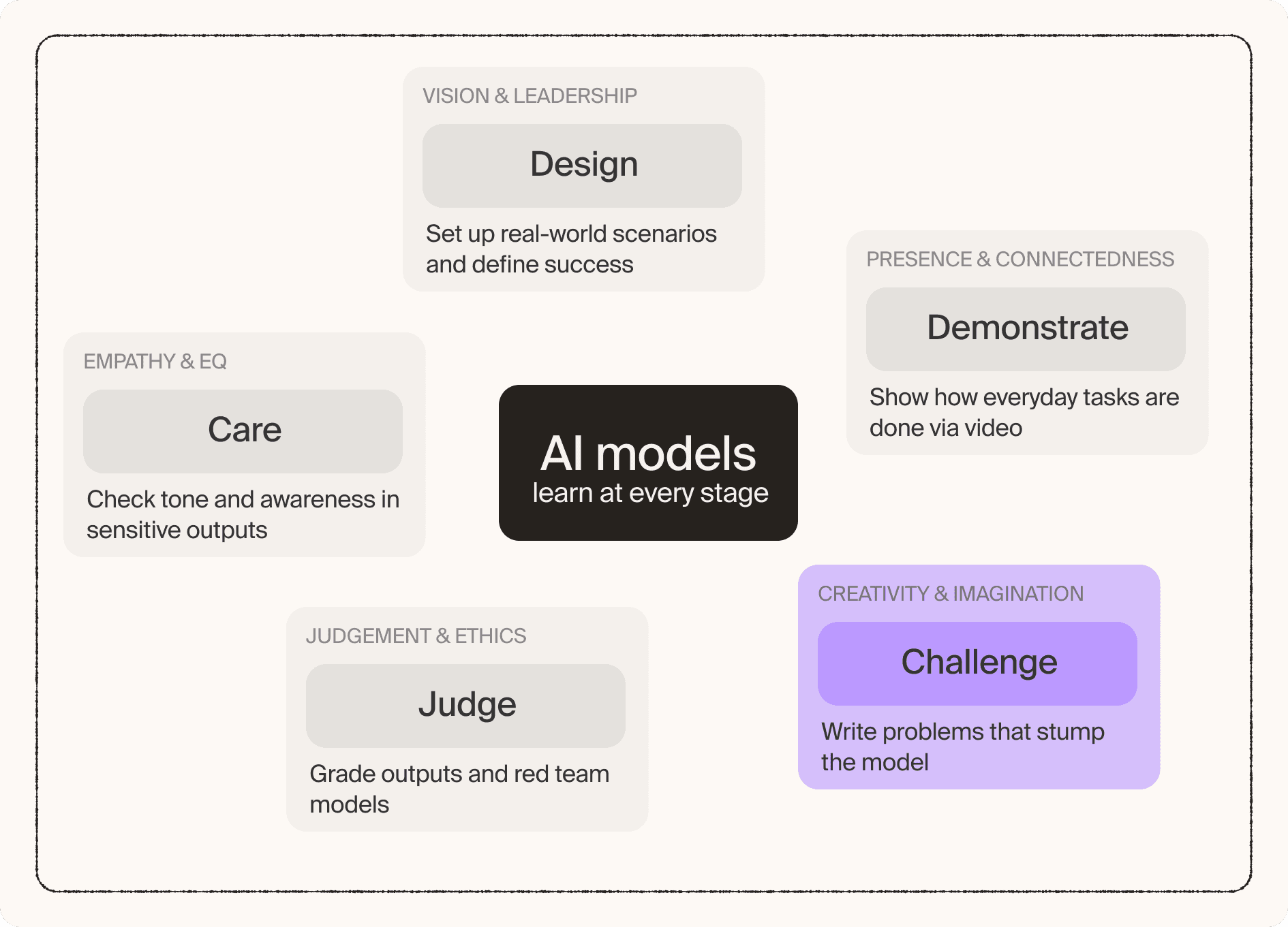
In AI training, writing problems that stump today’s best models is a skill in itself. A good test question has a clear, defensible answer, but no obvious shortcut. Coming up with one takes both expertise and a bit of creative mischief.
How to build it:
Try writing a few hard questions in your field. Could a smart non-expert answer them with a quick search? If so, dig deeper.
Keep a running list of the tricky cases you come across at work. Real-world edge cases make the best test problems.
Empathy and emotional intelligence
People bring AI their health worries, money stress, and relationship questions. A technically correct answer can still be the wrong one if it lands badly. After all, the model can only fake empathy for so long before it resorts back to standards and rules.
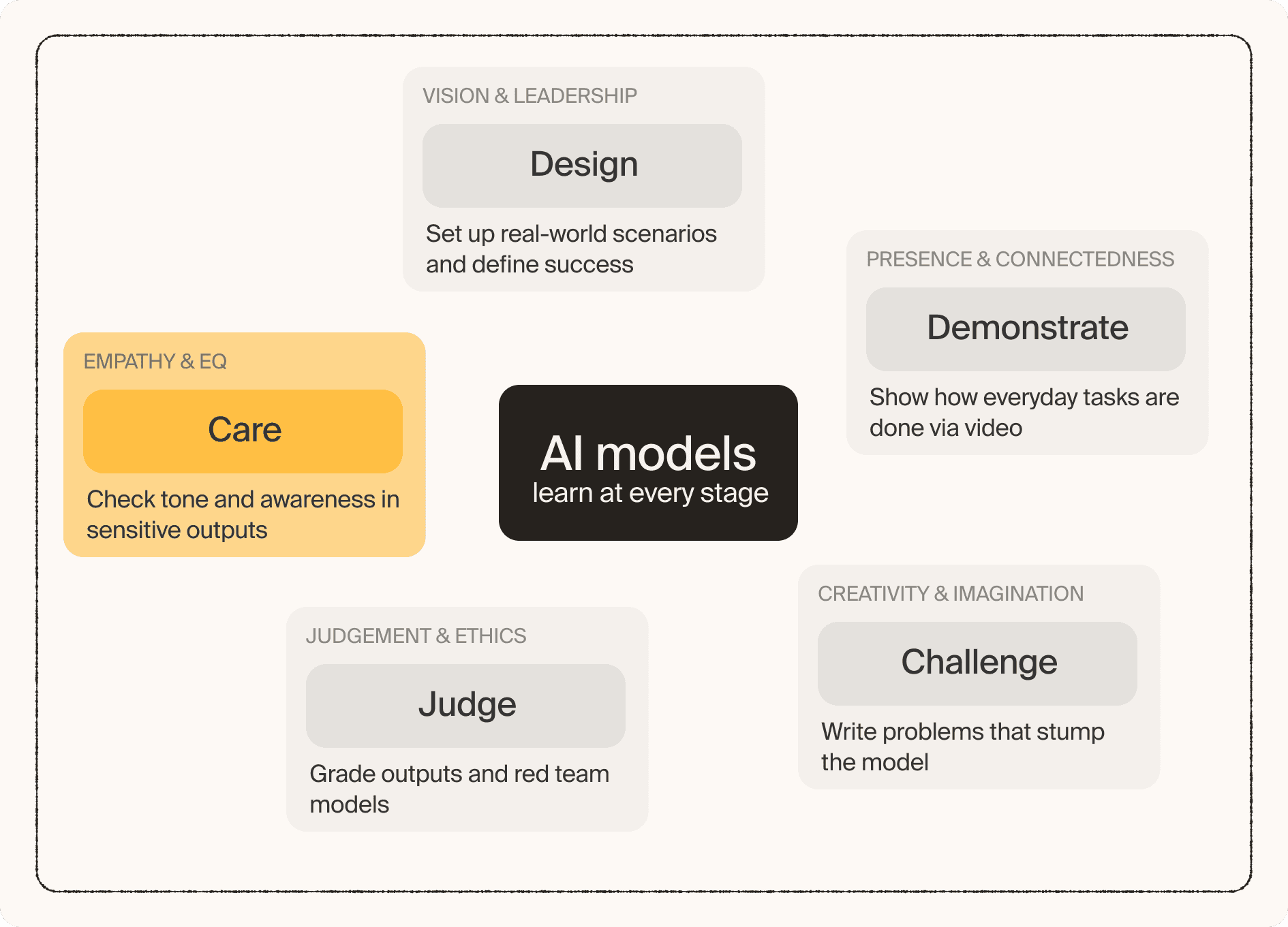
On some AI training projects, experts evaluate how AI responds to sensitive or personal questions. They check more than accuracy, instead looking at aspects like: is the tone right? Is it kind without being patronizing? Does it know when to suggest talking to a professional?
How to build it:
Notice how the best people in your field deliver difficult news and what makes it land well or badly.
Next time you use an AI assistant, read its answers to emotional questions and ask yourself: would this actually help a real person?
Hope, vision, and leadership
Setting direction, seeing the bigger picture, and getting others to follow through are still very human skills. And as AI agents take on longer, multi-step tasks, someone has to define what “done” looks like.
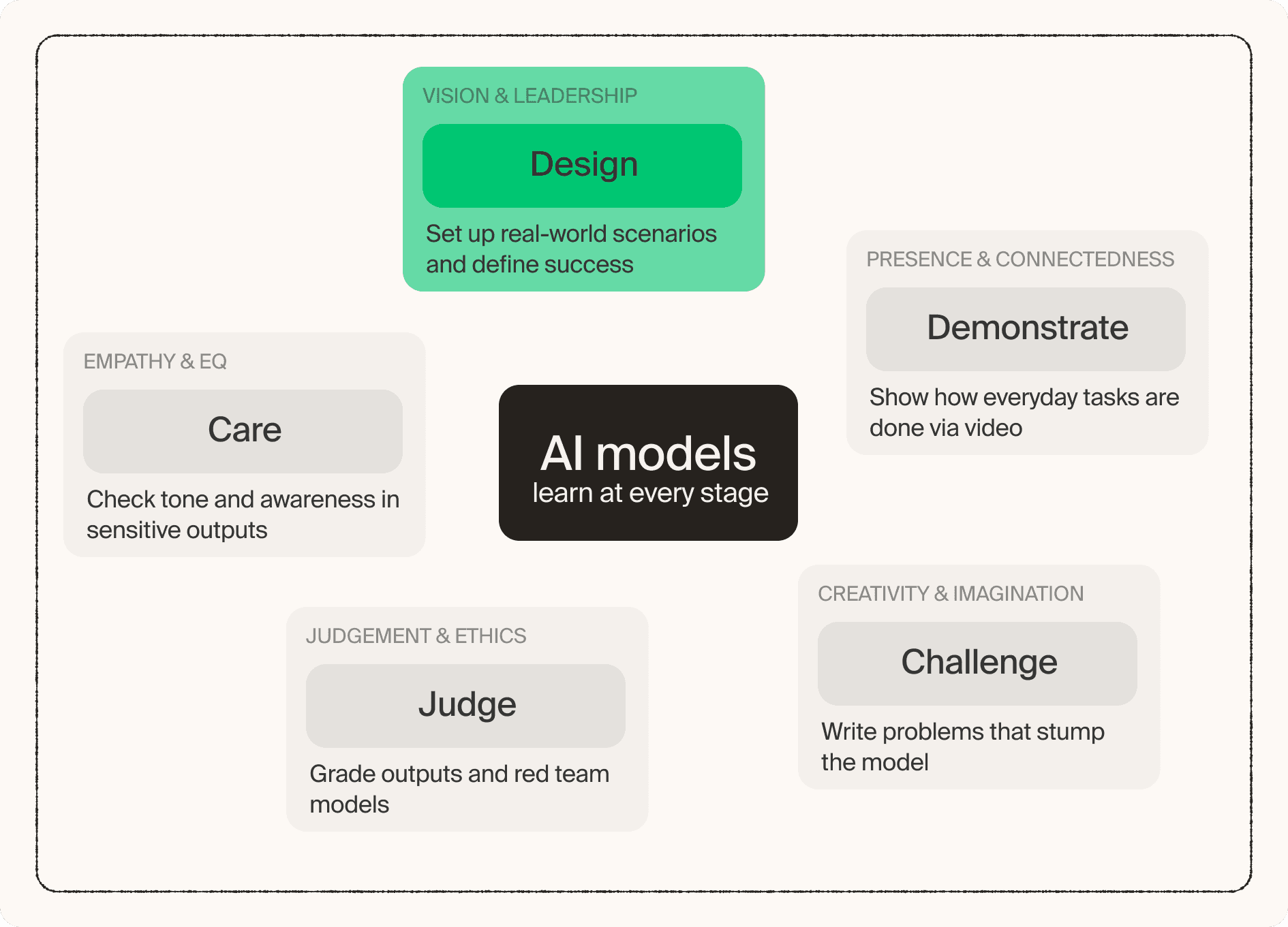
In AI training, some projects ask experts to design realistic scenarios for AI agents. They might set a goal, outline the steps needed to reach it, and define clear criteria for success. It’s a lot like briefing a new team member, except this one takes everything very literally.
How to build it:
Practice breaking a big task into steps and name where each step could go wrong.
Write instructions as if you were delegating to someone brand new. If they could follow it without asking questions, you’re on the right track.
Presence and connectedness
Some things you can only learn by being there: the feel of a tool in your hand, the order in which a chef plates a dish, the small adjustments a mechanic makes without thinking. AI has never had a body, so this kind of knowledge is hard for it to pick up.
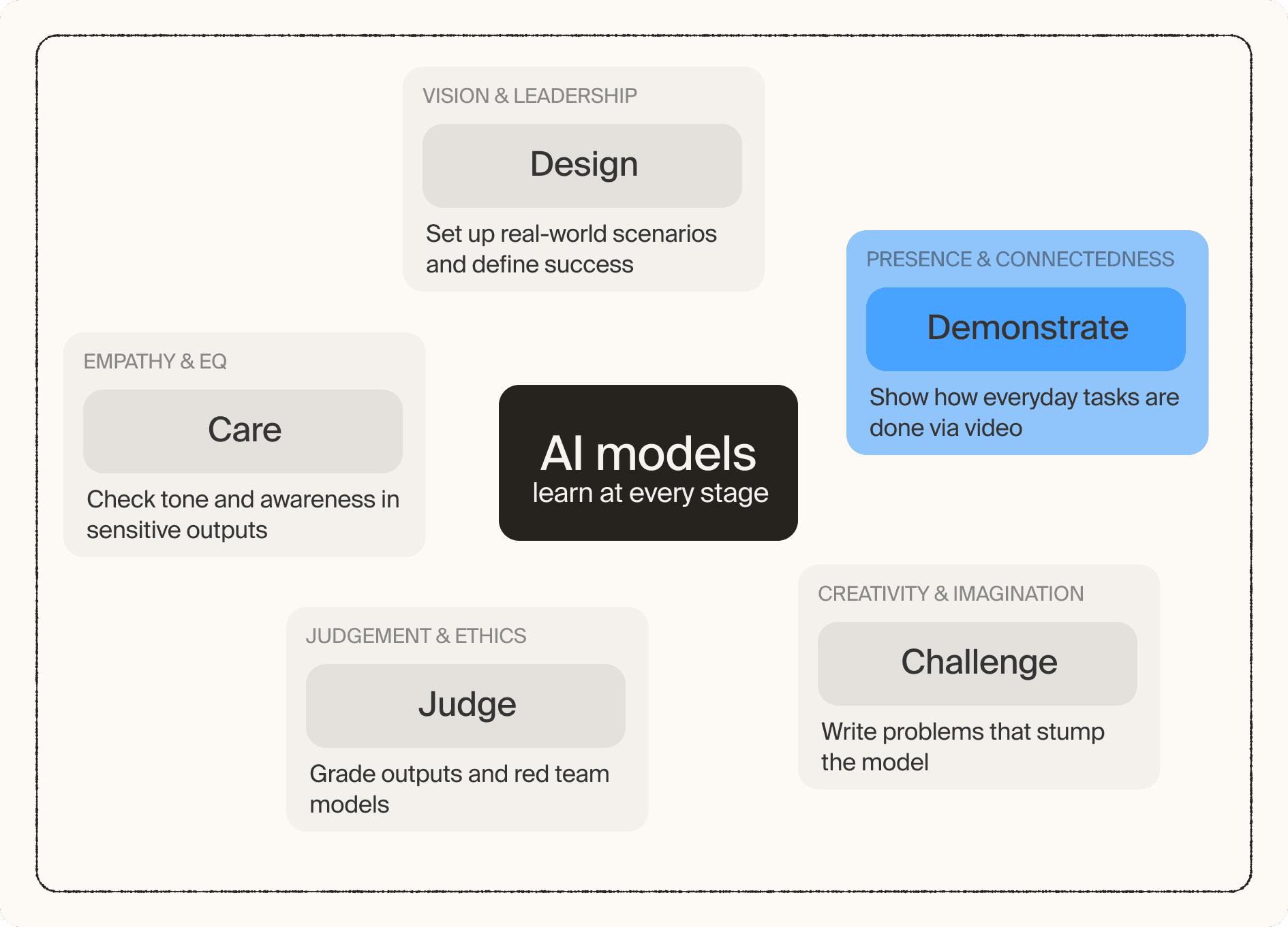
Robotics and first-person video AI training projects need people to demonstrate real-world tasks, record them and describe what they’re doing. Their hands-on experience becomes training data.
How to build it:
Don’t underestimate practical skills. Cooking, repairs, trades and caregiving are all valuable here.
Practice describing physical actions in short, precise steps. It’s harder than it sounds.
Entry-level now requires senior skills
Remember when “entry-level” meant taking time to learn the ropes? In AI-exposed fields, that’s changing fast.
The good news is that junior roles aren’t disappearing. The catch is that many of them now come with a much longer wish list. Globally, the most AI-exposed junior roles are 7x more likely to ask for skills usually expected of senior workers. That means things like:
Stakeholder management: Keeping different people informed, aligned and happy.
Mentorship: Helping others learn and grow.
Data-driven decision making: Using evidence, not intuition, to make decisions.
So why would a junior job need senior skills? Because AI now handles much of the routine work that used to fill a newcomer’s first year, like drafting, summarizing, and basic analysis. What’s left is judgment, coordination and responsibility — the exact skills that only humans can provide.
And employers are hiring for it. In the US, AI-exposed entry-level roles that now require a whole set of senior skills grew 35% between 2019 and 2025. Other junior roles in the same fields shrank by 10%.
PwC also notes that some graduates are already running teams of AI agents: setting priorities, checking their work and questioning their outputs. That’s a very different first job from making photocopies and taking meeting notes. It’s closer to managing than doing. And if it sounds a lot like AI training, that’s because it is. In both cases, AI does the first draft, and your job is to decide whether it’s good enough, and what to do if it isn’t.
How AI training helps you practice early
How do you build senior skills before you’ve had a senior job? AI training gives you a way to practice some of the most important ones, in your own field, on real projects by:
Questioning AI outputs: Every task asks you to look at an answer critically, check it against a clear standard, and spot what’s off. That’s the same muscle you’ll use when you’re managing AI agents at work.
Giving useful feedback: Writing a clear explanation of why something falls short, so someone else can act on it, is a core management skill. AI trainers do it all day.
Working within guidelines while using your own judgment: Projects come with detailed instructions, but they never cover every case. Knowing when to follow the rules and when to flag an exception is exactly what employers mean by “handles ambiguity.”
Breaking big tasks into steps: Whether you’re designing an agent scenario or checking a long chain of reasoning, you learn to see how complex work fits together, and where it can fall apart.
AI training won’t replace years on the job, but it’s a practical way to start building the skills employers are asking for now, before a job ad asks you to prove you have them.
Reality check: What the report does and doesn’t say
Headline numbers travel fast, so here’s what they do and don’t mean.
What the report says | What it doesn’t say |
|---|---|
Professionalized roles are growing faster | That Democratized roles are shrinking. Both tracks are still growing, at different speeds. |
AI-skilled workers earn a 62% wage premium | That AI training work earns this premium. It applies to full-time career roles that use or build AI. |
AI is raising the bar for junior roles | That junior roles are disappearing. Seniorized entry-level roles grew 35%. |
The data covers six continents | That every figure is global. Some, like the 187 vs. 93 skills comparison, are Australia-only. |
Article by

Mindrift Team


