AI insights
Article by
Mindrift Team

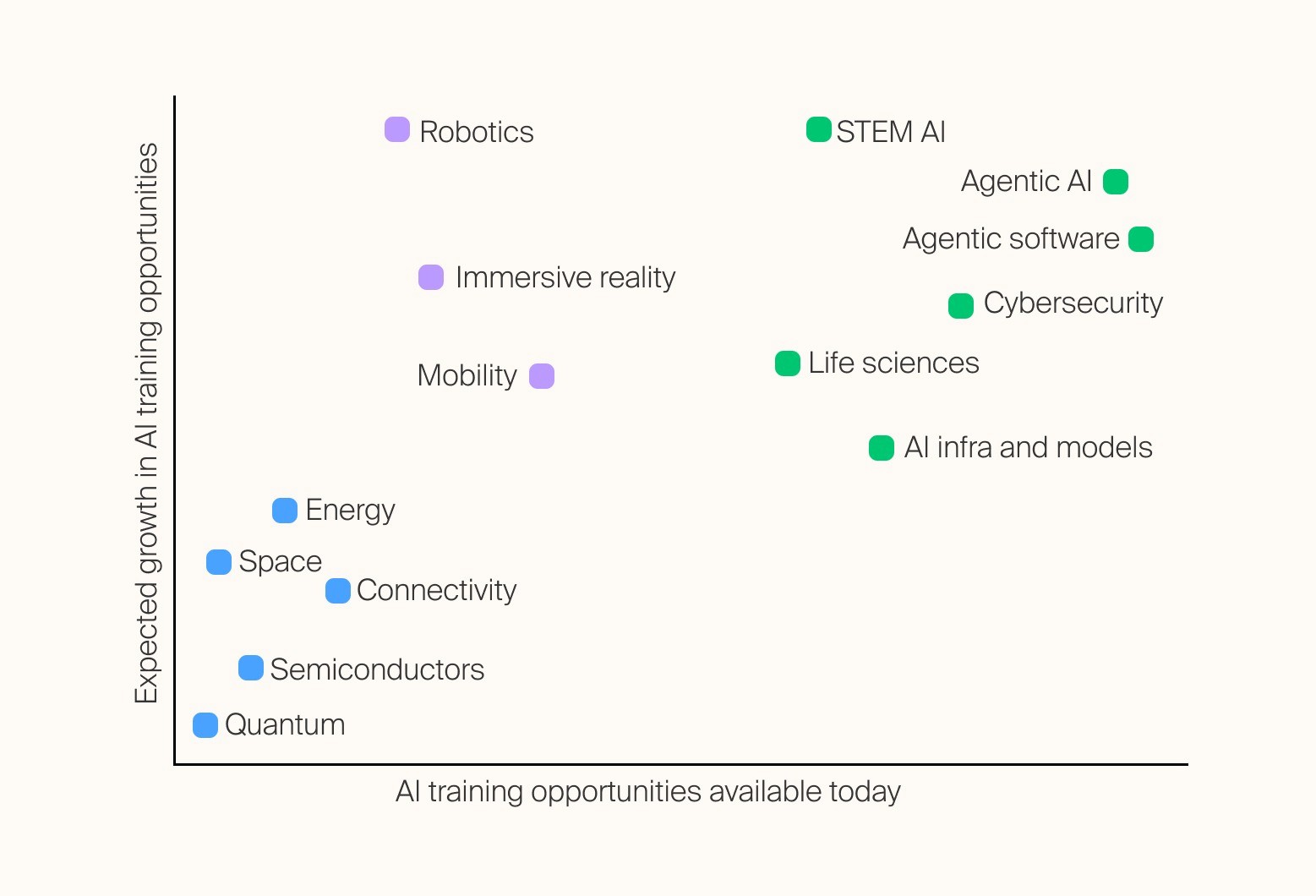
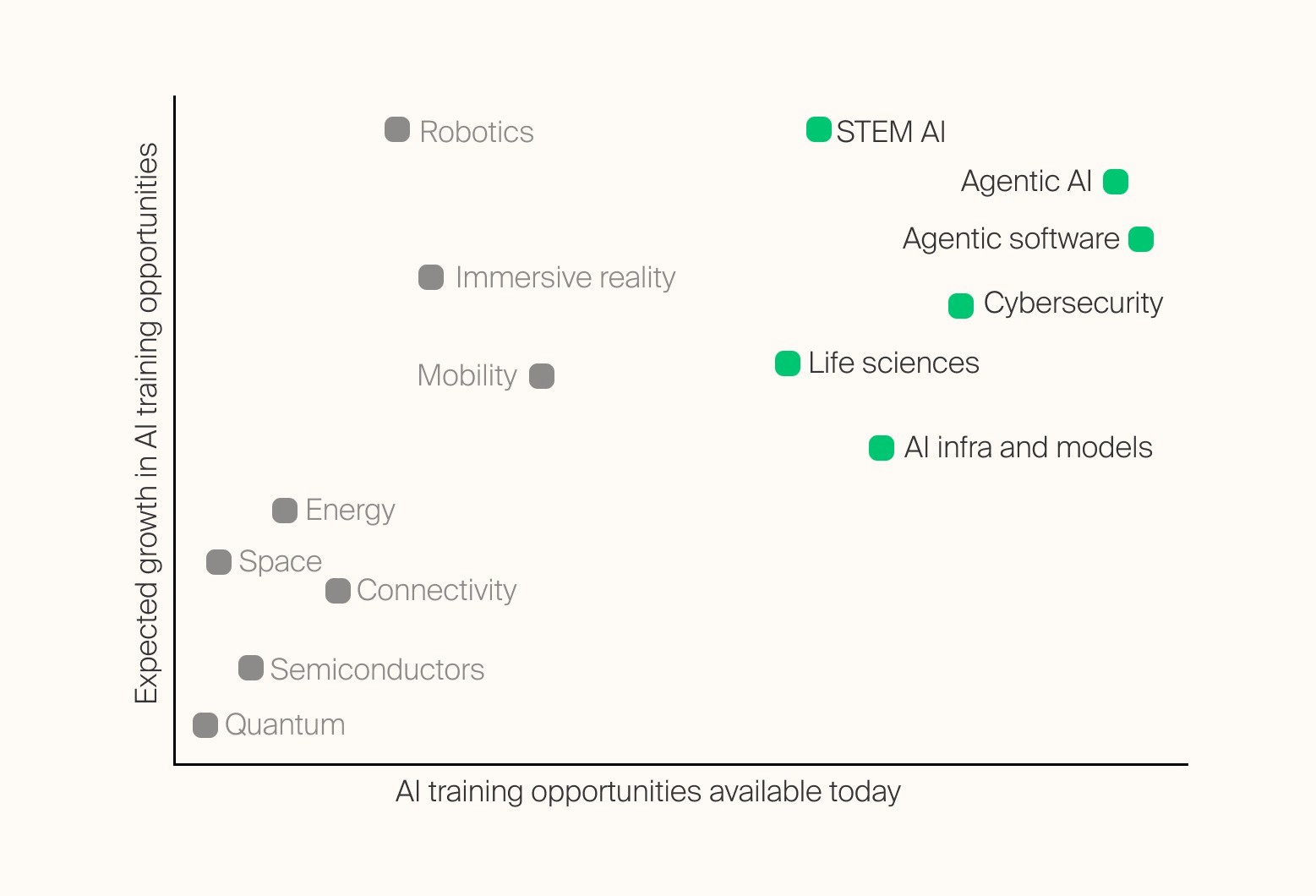
Strong signals: Where AI needs experts today
These six trends already rely on skilled domain experts to evaluate, verify, and improve AI, and that reliance is growing.
1. Agentic software development
Agent evaluations are "frameworks that benchmark, test, and monitor agent performance."
McKinsey Technology Trends 2026
AI coding agents now take on tasks independently, often overnight, and return finished code by the next morning. McKinsey points out that investment in these tools jumped from roughly $5 billion in 2025 to more than $61 billion in the first half of 2026, but output isn't the same as results.
In one study cited in the report, AI tools increased coding activity by 180%, while shipped releases rose only 30%. And the experts? They’re not sold just yet — only 3% of developers say they highly trust AI-generated code.
What this means for AI Trainers
The focus is shifting towards validating whether what gets built actually performs as intended. The more code agents produce, the more that validation matters. AI Trainers contribute by reviewing code written by AI agents, grading how an agent approached a problem, and explaining where and why it went wrong. Focus on developing skills like:
Code review: Practice reviewing other people's code on open-source projects, focusing on logic errors and edge cases, not just style.
Test design: Learn to write unit tests and clear specifications. They're the backbone of checkable coding tasks.
Using AI coding tools yourself: Spend time with tools like Claude Code or Cursor so you know where they typically fail.
2. Agentic AI
"The key to unlocking the value of agentic AI is evaluations.”
McKinsey Technology Trends 2026
AI agents can now take on long, complex tasks from start to finish. Companies are using them widely, but most aren't seeing results they expected just yet.
According to METR benchmarks cited in the report, top models can now handle software tasks that would take a skilled human about 12 hours, with a 50% success rate. Yet while 89% of organizations regularly use AI, only 37% report any positive impact on earnings.
What this means for AI Trainers
Evaluating the full sequence of an agent's actions: which tools it used, how it handed off tasks, and whether it stopped to ask when it should have is something only human trainers can do. Projects in this area also include writing realistic multi-step scenarios for agents to attempt — another key aspect of being a domain expert with real-life experience in the field. Focus on developing skills like:
Process thinking: Get comfortable breaking complex tasks into steps and identifying where each one could fail.
Clear written reasoning: Practice explaining why a decision was wrong in detail.
Domain knowledge: Agents are being deployed in finance, customer service, operations, and more, so expertise in any business area is useful.
3. AI for scientific discovery and engineering
"Questions remain regarding the consistency and validation of AI-generated scientific outputs."
McKinsey Technology Trends 2026
New to this year's report, this trend covers AI proposing drug candidates, new materials, and engineering designs. At Berkeley Lab's A-Lab, AI suggests new compounds and robots test them. Investment is surging, including Isomorphic Labs' $2.1 billion funding round.
But uncertainties still exist, including reproducibility of AI-generated science and lack of access to high-quality scientific data. This means AI is generating scientific ideas faster than ever, but many of them still need an expert to confirm whether they hold up.
What this means for AI Trainers
AI training opportunities for scientists, engineers, and others in STEM fields still dominate AI training platforms. Expert humans are needed to review AI reasoning in their field, catch results that look like breakthroughs but aren't, and create expert-level problems that test whether AI truly understands the science. Focus on developing skills like:
Critical reading: Practice spotting flawed methods or unsupported conclusions in published papers.
Problem writing: Try writing difficult questions in your field that have one clear, defensible answer.
Staying current: Follow how AI tools are being used in your discipline.
4. Cybersecurity and trustworthy systems
"The bottleneck might shift from detecting threats to distinguishing real ones from the noise."
McKinsey Technology Trends 2026
AI is making both attackers and defenders faster. The challenge now is figuring out which alerts actually matter and making sure AI agents don't overstep. More than three-quarters of vulnerabilities are now "zero day," meaning an exploit already exists by the time they're disclosed.
In one test cited in the report, an AI agent followed dozens of steps to turn a minor flaw into full unauthorized file access. Enterprises are trying to figure out a way to confirm that AI agents stay within the permissions they've been given because a single agent behaving outside its limits can create serious risk.
What this means for AI Trainers
A critical AI training area is red-teaming, meaning deliberately probing AI systems for unsafe or unintended behavior. These tasks require trainers to act like malicious characters to pinpoint flaws in the system.
Other projects include judging whether an agent stayed within scope and helping AI tell real threats from false alarms. Focus on developing skills like:
Security fundamentals: Certifications or experience with hands-on platforms like Hack The Box are helpful.
Adversarial thinking: Practice asking "how could this be misused?" about any system you use.
Careful documentation: Clear write-ups of what you found and how you found it are as valuable as the finding itself.
Critical reading: Practice spotting flawed methods or unsupported conclusions in published papers.
Problem writing: Try writing difficult questions in your field that have one clear, defensible answer.
Staying current: Follow how AI tools are being used in your discipline.
5. AI infrastructure and model architectures
World models are "architectures designed to simulate physical environments, predict outcomes, and support planning."
McKinsey Technology Trends 2026
Most of this trend covers the data centers, chips, and power needed to run AI, with data center spending projected to reach nearly $7 trillion by 2030.
The model side is changing too: reasoning models, multimodal models, and world models that simulate the physical world. Instead of one giant AI for everything, companies are moving toward many specialized models, including ones that understand images, video, and physical space.
What this means for AI Trainers
Every specialized model needs to be tuned and tested for its specific purpose, and multimodal models need people who can judge more than text. AI trainers contribute to projects that improve AI output across formats, like images, audio, and video.
Other tasks include testing whether a world model's predictions match how the real world actually behaves and helping specialized models meet the standards of their field. Focus on developing skills like:
Multimodal comfort: Get used to evaluating images, audio, and video carefully, not just text.
Real-world intuition: Knowledge of physics, mechanics, or how things behave physically helps when judging world models.
Specialization: Pick a domain and go deep. Specialized models need specialized evaluators.
6. Future of life sciences and bioengineering
AI is "surfacing more promising candidates than the system can absorb."
McKinsey Technology Trends 2026
Gene-editing therapies now offer curative treatments for some patients with sickle cell disease. AI is accelerating protein design and drug discovery, but it doesn't remove the hard steps that come after: lab validation, clinical trials, and regulatory approval.
AI models are helping scientists produce more promising drug and biology ideas than labs can test. The biggest bottleneck is figuring out which ones are worth pursuing.
What this means for AI Trainers
In healthcare and biology, a confidently wrong AI answer has real consequences for patients. Clinicians, lab scientists, and biomedical experts are needed to evaluate AI output in their specialty. That can include reviewing medical reasoning, checking biological plausibility, and flagging answers that sound right but aren't. Focus on developing skills like:
Evidence-based thinking: Practice judging claims against clinical guidelines and published research.
Precision in language: Small wording differences matter a lot in medicine, so train yourself to notice them.
Awareness of AI in your field: Follow how AI is being used in diagnostics, drug discovery, or research in your area.
Growing signals: Where AI training is heading next
These three trends involve AI learning to operate in the physical world. Trainer opportunities are quickly gaining steam here and are expected to grow the fastest.

7. Future of robotics
Robots are moving from pre-programmed machines to AI-driven systems that act on camera input and plain-language instructions. According to the report, humanoid robot shipments reached 18,000 units in 2025 but fine manipulation (grasping and handling objects) remains one of the hardest problems.
McKinsey notes that more deployed robots require more real-world data to improve them, and that data needs human input to be useful.
Tips for AI Trainers
Human contributors are needed to demonstrate physical tasks so robots can learn from them, label videos of robot and human actions, and evaluate whether a robot's behavior was safe and correct. If you want to get a jump start on these opportunities, focus on:
Physical task expertise: Skilled trades, cooking, caregiving, or manufacturing experience all translate well.
Attention to detail: Practice breaking physical actions into small, precise steps.
Safety awareness: An instinct for what could go wrong in a physical environment is valuable.
8. Immersive-reality technologies
Immersive technology, otherwise known as wearable tech, is shifting from entertainment toward practical use. McKinsey says devices like AI “smart glasses” can capture real-world spatial context and human actions that are harder to obtain than language data.
Tips for AI Trainers
Egocentric, first-person video, and data collection projects focus on recording everyday activities from a first-person perspective and labeling what happens in those recordings step by step. These projects are among the most accessible, since everyday skills matter most:
Consistency: Following recording instructions precisely matters more than technical skill.
Clear labeling: Practice describing actions in short, specific, unambiguous terms.
Everyday expertise: Being good at cooking, repairs, crafts, or other hands-on tasks makes your recordings more valuable.
9. Future of mobility
It’s not the future, it’s now — robotaxis are now a real commercial service in many cities and autonomous trucks are becoming driverless on select routes. Global electric car sales reached 21 million in 2025 but McKinsey predicts that fully autonomous personal vehicles will scale more gradually.
Tips for AI Trainers
Autonomous vehicles have to handle rare, unexpected situations safely, and those situations are hard to train for. Emerging opportunities focus on specialized teams that review unusual driving scenarios and help AI understand the reasoning behind safe decisions. Real-world experience is the most relevant background, along with:
Professional driving or logistics experience: Commercial drivers, dispatchers, and fleet managers bring valuable instincts.
Scenario thinking: Practice imagining unusual road situations and how they should be handled.
Following the industry: Keep an eye on where robotaxis and autonomous trucks are expanding.
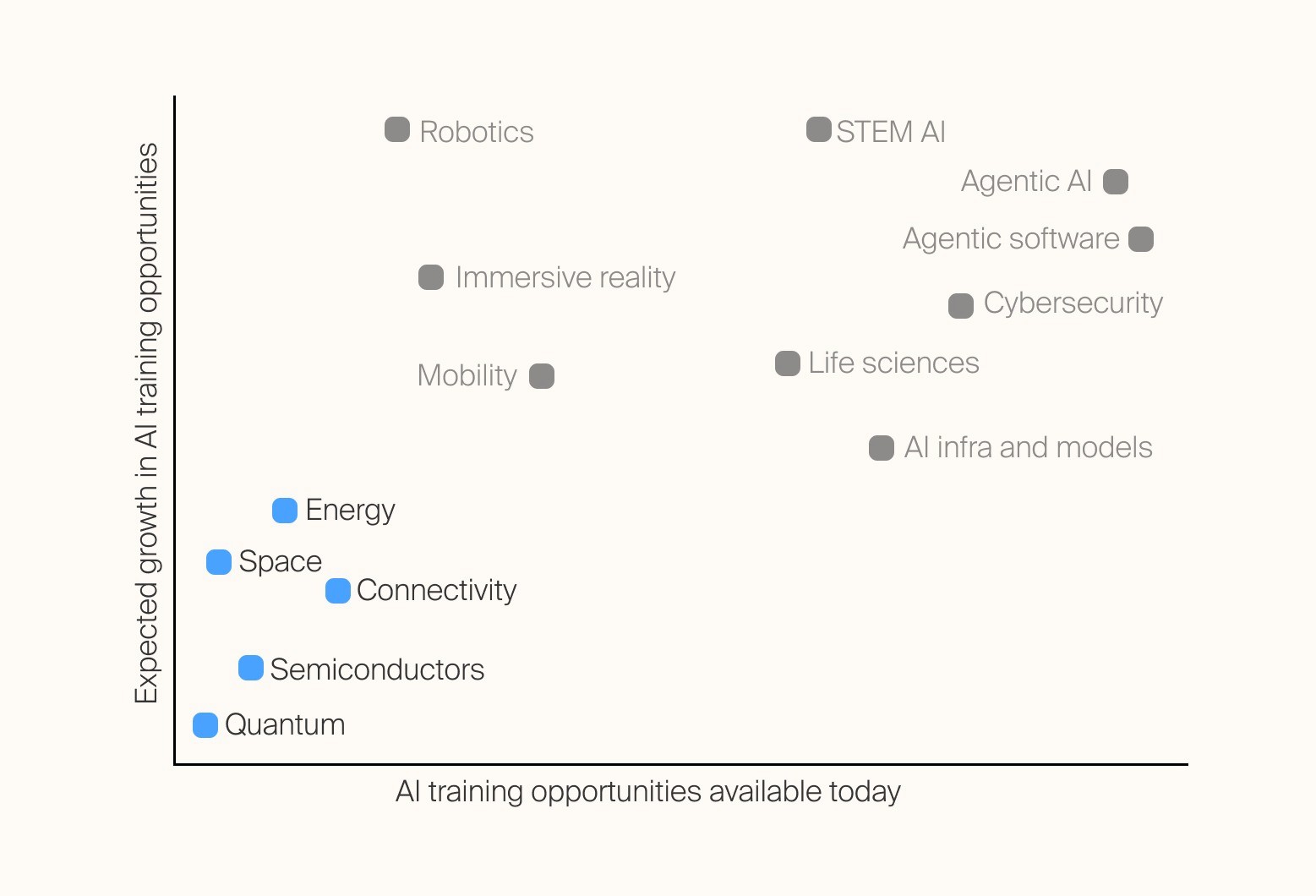
Faint signals: Opportunities to watch for the future
These five trends shape the foundation AI runs on but the AI training opportunities are only a potential at the current moment.
10. Future of energy and sustainability technologies
McKinsey defines digital energy systems as "AI-enabled forecasting, grid digital twins, energy management software." Essentially, AI requires a ton of electricity and the grid is struggling to keep up.
Data centers could account for 14% of US power demand by 2030, and more than 2,500 gigawatts of energy projects are stalled worldwide waiting for grid connections. Yet energy availability determines how fast AI can grow, which also affects every other trend on this list.
As utilities adopt AI forecasting and digital twins, energy professionals could become valuable subject-matter experts for evaluating those models.
Future opportunities here are mostly for people already in the field, which can guide career pivots and education decisions.
11. Future of space technologies
Satellites are still capturing images from space, but AI is now turning those pictures into useful information including essential insights for agriculture, insurance, climate monitoring, and disaster response. Dealing with satellite imagery accurately requires specialized knowledge that AI still needs help learning. AI training opportunities are still very limited and difficult to find.
As this field grows, experts in geospatial analysis, agriculture, or environmental science might be in demand to help AI interpret satellite imagery correctly.
12. Advanced connectivity
AI needs fast, reliable connections everywhere, and telecom companies are using models to run their own networks. Low Earth orbit satellites could eventually capture close to 20% of the addressable market for existing fiber because better connectivity lets AI run in more places, from factory floors to remote areas.
This field is extremely limited for AI trainers today but network engineering expertise could become useful for evaluating AI network-management tools down the line.
13. Application-specific semiconductors
Tech giants like Amazon, Google, Meta, and Microsoft are designing custom chips built specifically for running AI models, rather than relying only on general-purpose processors. Cheaper AI means more models get built, and every new model will need to be trained and evaluated.
This doesn’t present a direct AI training opportunity, but the impact of cheaper AI and more models directly creates more AI training projects for experts and impacts every trend above.
14. Quantum technologies
Quantum computing uses the rules of quantum physics to solve complex problems that regular computers would take far too long to crack. This trend is promising, but it isn't solving real-world problems better than regular computers yet.
McKinsey estimates that this trend could create up to $2.7 trillion in value by 2035, and more than 300 organizations are already collaborating with quantum companies, but practical use is still largely experimental. When quantum matures, it could change fields like cryptography, materials science, and drug discovery.
No AI training opportunities are available here but for the curious, free resources like IBM's Qiskit tutorials offer an accessible introduction.
Article by

Mindrift Team


