AI insights
Article by
Mindrift Team
Right now, somewhere, a customer service rep is handling a call that would have stumped them six months ago. A junior consultant is turning in work that surprises their manager. A writer is getting unstuck.
None of them are thinking about the people who helped build the AI they're using. But those people — the AI trainers, the domain experts, the ones who spent time teaching a model how to be actually useful — are a big part of the reason any of it works.
The AI that real people use day-to-day to draft emails, write code, search through documents, or work out problems is shaped by the humans who teach it how to behave.
The surprising place where AI shines brightest
When researchers started measuring AI's impact on real workplaces, they expected to find the biggest gains among the most experienced workers, the ones who'd know exactly how to use a powerful tool. They found the opposite.
Harvard Business School and Boston Consulting Group, studied 758 consultants who were given realistic knowledge work tasks, with half of them having access to AI and half working without it. The AI users finished more tasks, finished them faster, and produced work that was rated substantially higher in quality. Great results all round but the standout finding was surprising. Junior consultants improved their performance by 43%. Senior consultants? Around 17%.
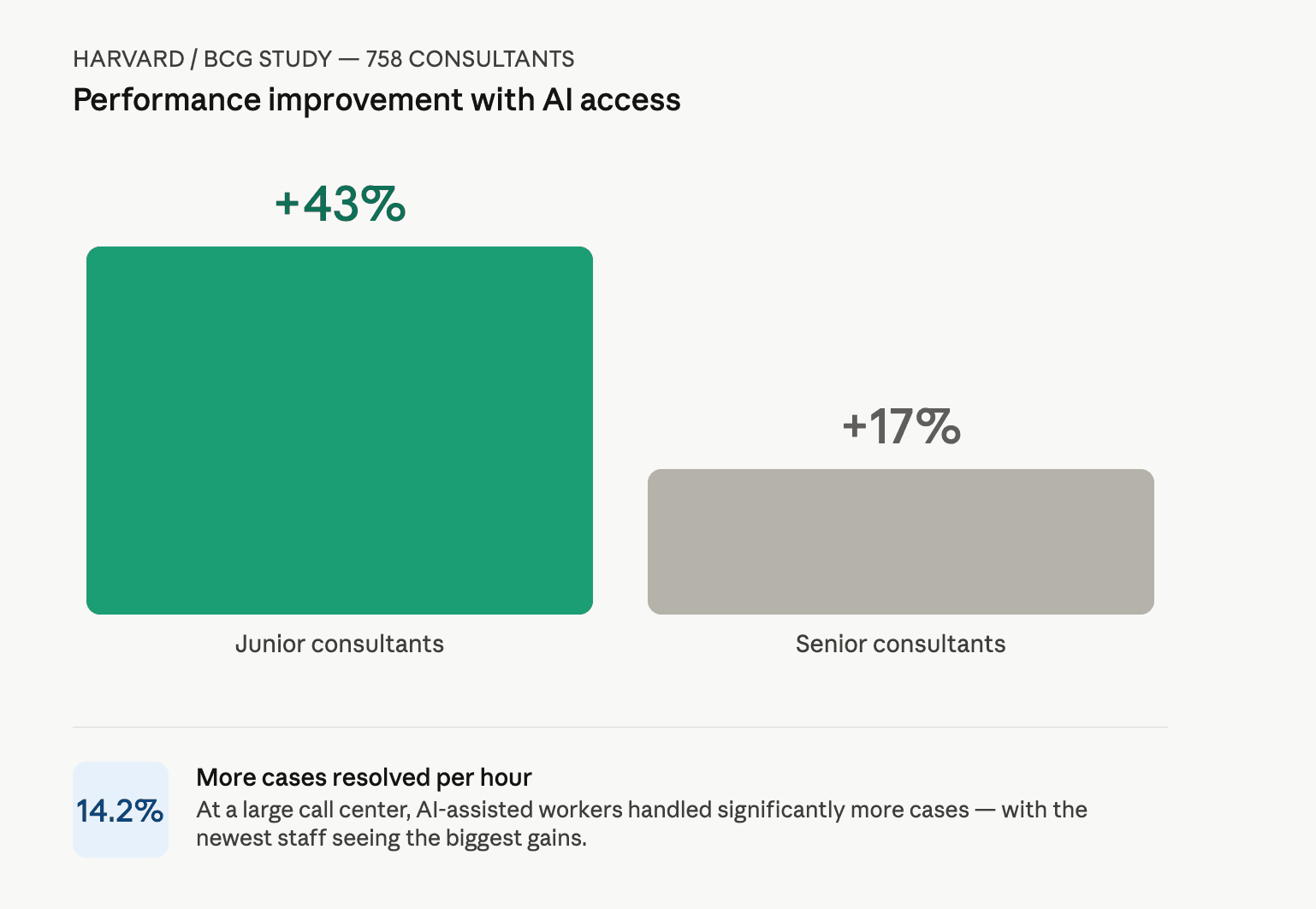
The same pattern showed up at a large call centre, where workers with an AI assistant resolved around 14.2% more cases per hour than their colleagues, with newer staff seeing the biggest jump of all.
Turns out, AI can be a remarkable equalizer. It gives people access to knowledge, context, and capabilities they haven't yet built through experience, right when they need it most. For someone early in their career, that’s the difference between thriving and struggling in the first year on the job.
The creative co-pilot people didn't expect to want
Ask most people what they use AI for at work, and "creativity" probably isn't the first answer that comes to mind. But researchers have found something quietly remarkable happening in that space.
When people write alone, their creativity is their own. It’s raw, unfiltered, and entirely theirs. When they're handed a finished AI-generated draft and asked to edit it, something slips. The output might be polished, but the person producing it feels less like an author and more like a proofreader. Their sense of creative ownership drops, and so does their output.
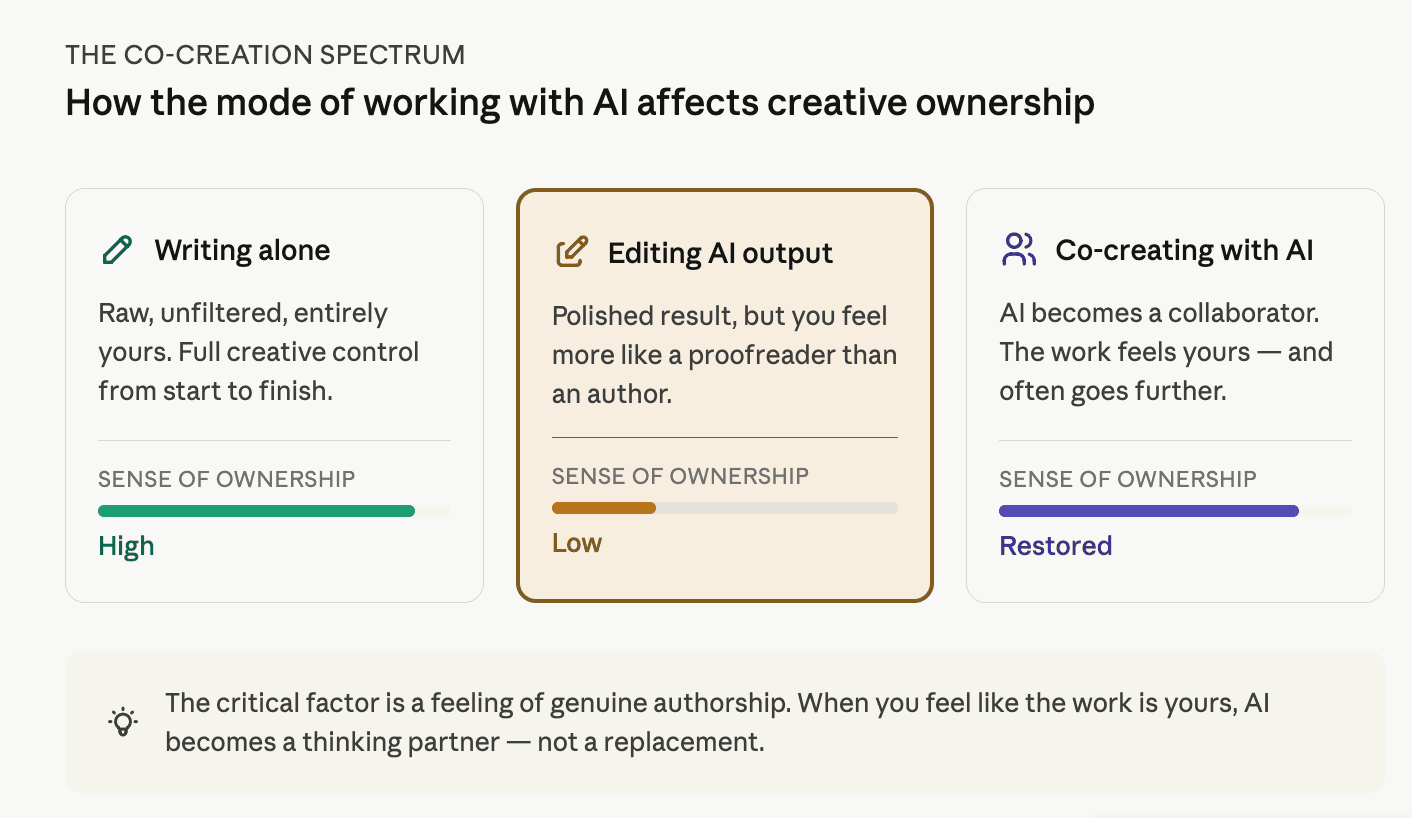
But when people co-create with AI, that creativity deficit disappears almost entirely. The critical factor, researchers found, is a feeling of genuine authorship. When you feel like the work is yours, AI becomes a collaborator rather than a replacement. And when that happens, people produce things they're proud of.
This is the version of AI that writers, designers, marketers, and strategists are starting to discover. Not AI as a shortcut, but AI as a thinking partner — something that helps you take your own ideas further than you could alone.
The humans who end the day with more energy
There's a quieter kind of win that doesn't get its own pie chart in reports, but might matter just as much: people finishing their days less depleted.
When AI takes over the repetitive parts of a job like searching, formatting, writing the first draft of the thing nobody wants to write, it gives people back some mental space. It boosts their capacity to care about the part of their work that actually needs their full selves.
And research backs this up. Workers whose AI tools reduce routine tasks tend to report higher job satisfaction, precisely because more time opens up for the challenging, engaging work they actually want to be doing.
For anyone building or shaping AI, that's worth holding onto. Every interaction that gets a little sharper, a little more contextually aware, a little better at understanding what someone actually needs adds up to real differences in how people feel about their days.
The part that's still a work in progress
AI is excellent at handling mundane, repetitive tasks, but how does it perform in work scenarios that are a bit more complex?
An independent research group, Model Evaluation and Threat Research (METR), ran a study in 2025 where experienced developers completed real coding tasks. Some developers had access to AI tools, others didn’t. On paper, it should have been a productivity slam dunk. In practice, the developers using AI took 19% longer.
This doesn’t demonstrate that AI is bad for developers, just that the terrain is still uneven. The same capabilities that make AI transformative for a junior consultant or a customer service rep can create friction for an expert working in deeply familiar, complex territory.
AI doesn't help everyone equally in every context, and understanding where there’s still growing room is critical. It translates directly to more demand for complex, domain-specific AI projects and a need for professionals across different industries to share their knowledge.
What this means for the people training the AI
The AI that real people actually benefit is human in its understanding. It knows when to give a direct answer and when to help someone think.
That kind of AI is built by people who evaluate how models respond, who catch the moments where they miss the tone or misread the intent, who push for responses that feel genuinely useful rather than just technically correct. The projects and tasks you complete are helping create something that ends up in people's real days.
Want to help shape the future of AI for real people across the world?
Not sure if you’re ready? Learn more about AI training.
Article by

Mindrift Team


