AI insights
Article by
Mindrift Team

Artificial intelligence is revolutionizing the way we communicate — and it's worth taking a moment to unpack what that really means. Whether you're a seasoned tech enthusiast or simply someone who's curious about the fascinating world of large language models, one thing is clear: AI is reshaping our digital landscape in ways that are both exciting and nuanced.
Full disclosure: AI wrote that introduction. Did you catch that? The cliche use of revolutionizing, unpack, and digital landscape? The ever present em dash? The uncanny, almost-human-but-not-quite tone of voice? We may be the ones training models, but somewhere along the way, AI found its own very distinct voice.
In this deep dive, we'll explore the key insights … just kidding. The rest of this article will be 100% human-written as we take a look at the language of AI, how we got here, and where this is all heading.
What does AI sound like?
Take a second to scroll through Bloomberry’s AI Writing Patterns Database and see how many of these patterns you’ve seen before. The database has catalogued over 4,000 phrases, 129 cadence structures, 17 hook patterns, and more, based on common AI outputs.
Phrase | Pattern type | Usage |
|---|---|---|
At its core | Framing phrase | Very high |
When it comes to | Transition filler | Very high |
Let's unpack | Hook phrase | Very high |
Delve | Vocabulary cliche | High |
Some of Bloomberry’s top AI vocabulary patterns.
But the “language of AI” is more than its vocabulary, although that is a massively recognizable quirk. AI also tends to sound overly enthusiastic when there’s no reason to. Certain word choices, like absolutely or certainly, can make AI models sound like that one coworker who’s always too chipper for their own good.
Why does AI sound like that?
This might be the more interesting question. We know what AI sounds like. We’ve seen it everywhere, from our company’s decks to LinkedIn posts to published books. But how did it get this way?
Last year, Tom S. Juzek and Zina B. Ward of Florida State University set out to answer this very question. In a peer-reviewed linguistic study, they analyzed over 5.2 billion tokens from 26.7 million scientific abstracts on PubMed. This led them to identifying 21 “focal words”, including terms like delve, intricate, underscore, and groundbreaking. The use of these words has spiked dramatically since 2023 and are heavily overused by the major AI models.
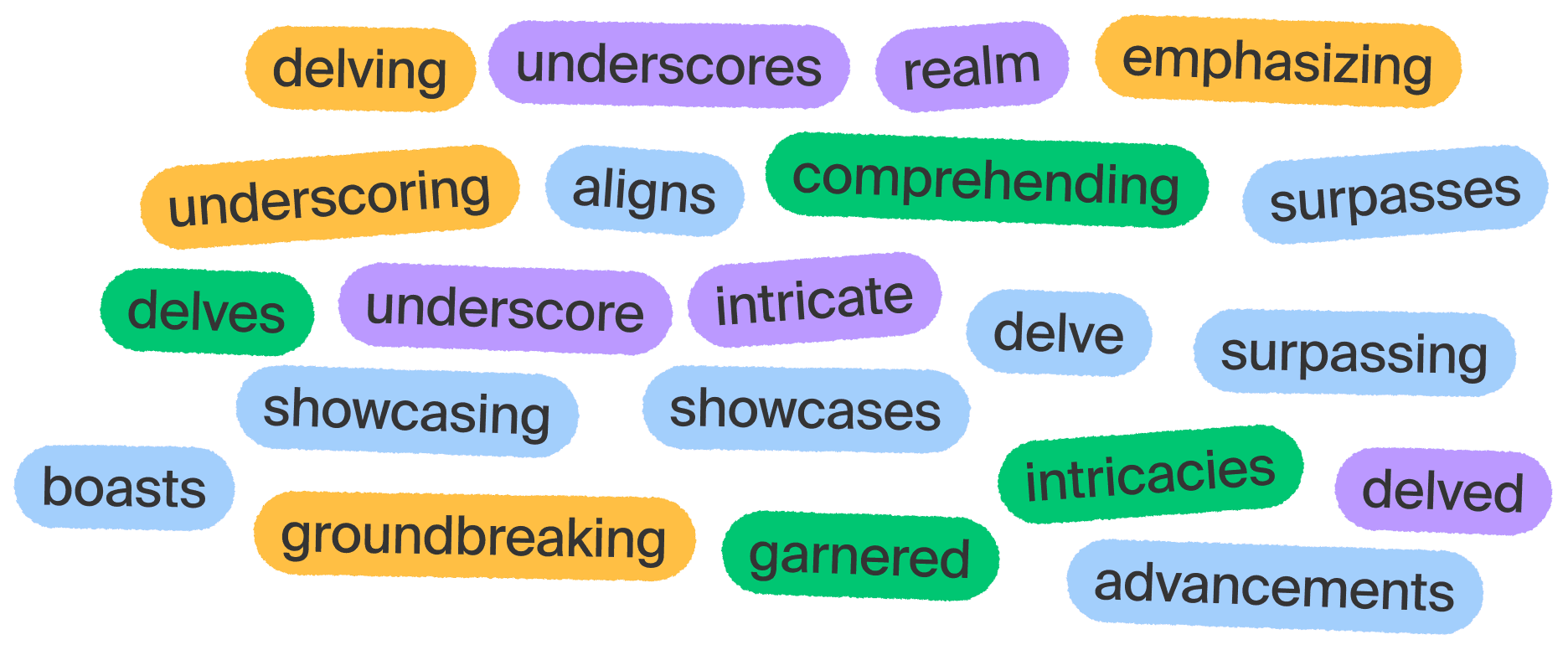
Juzek and Ward’s 21 focal words.
One theory on how this happened has nothing to do with training data and the model architecture. It might actually come down to our own human bias.
“Rushed human evaluators might base their evaluations on the presence of particular words rather than on content, as the former is easier and quicker to evaluate than the latter. If certain words are treated as a proxy for quality, that could explain their overrepresentation in LLM outputs.”
Juzek and Ward theorized that Reinforcement Learning from Human Feedback (RLHF) might be the real culprit. During RLHF, AI Trainers are shown two AI-generated responses to the same prompt and asked to pick the better one. These preferences are then used to train a reward model that guides the AI toward outputs humans like more. In their study, Juzek and Ward suggested that human raters who scored AI may have unconsciously preferred text that sounded smart and polished, rewarding those words until the model learned to reach for them by default.
“The irony is that, if our hypothesis about RLHF proves correct, this heuristic has shaped model training as well. LLMs may be undercutting the very same heuristic that has shaped their own lexical preferences.”
AI learned to sound smart by mimicking what humans found impressive. But now it does it so often and so
obviously that it’s become somewhat of a meme. It's like your one uncle who does the same magic trick at every family gathering — eventually, we stop being impressed.
Another theory is that AI models tend to favor “safe” or “common” word choices, which causes them to default to the repetitive, predictable language they love. This also leads to repetitive loops — you ask a question, the AI produces an answer that sounds okay but doesn’t actually help, and repeat.
If you’ve ever asked AI to help you brainstorm a business idea and its first piece of advice was to “research” or “get to know your audience”, you understand. These bland, vague outputs are the model’s comfort zone.
So why does it even matter?
When university students are beating AI detectors by using AI, companies are dealing with lawsuits because of AI errors, and all of us are starting to sound a little more like AI every day — it matters. Not to sound like AI, but artificial intelligence really is making its way into every corner of our lives.
The Juzek and Ward study pointed out that today’s AI cliches won’t randomly disappear one day, they’ll become tomorrow’s training data. And if that's what goes into the next generation of models, it will create an infinite loop. Which brings us to why this matters beyond the jokes about "delve" and rocket ship emojis.
AI didn't invent this way of speaking by itself. It learned to write this way because humans kept rewarding it. A response that opened with "Certainly!" and promised "actionable takeaways" scored well, so the model learned to lead with "Certainly!" and promise "actionable takeaways." Now multiply that by millions of ratings across thousands of evaluators.
That’s why the only way to break the cycle is to contribute to building better, safer, more helpful AI models. Every AI training task is demonstrating human preferences. When you’re refining outputs, you’re showing AI how it should sound. When you’re rating responses, you’re telling the model what humans actually want to hear.
Article by

Mindrift Team


