Article by

Every task completed on the Mindrift platform contributes to something bigger — but what exactly happens after you hit "submit"?
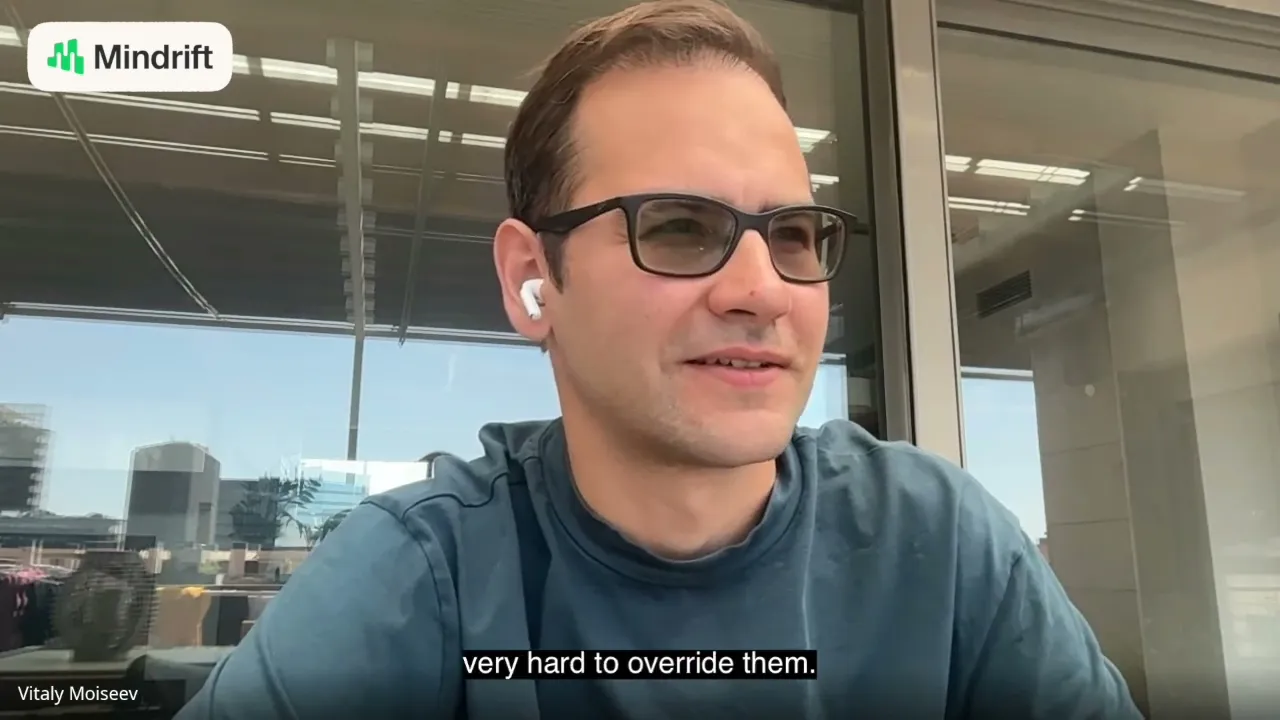
To answer that question, we sat down with Vitaly Moiseev, ML Development Lead, to talk about how AI models actually learn from human input, why diversity of contributors matters more than any single expert, and where AI training is heading next.
Whether you're a seasoned contributor or just considering your first task, this conversation will give you a clearer picture of the real impact your effort has on the AI models millions of people use every day.
What happens after you submit a task
AI Trainers at Mindrift often understand how to do their tasks, but not what actually happens after they hit the submit button.
“First, we run a set of automated checks. Each project has specific quality criteria that the task is evaluated against. If our system flags any concerns, the task gets routed to a human QA — another expert who reviews your work, assesses whether it meets the standards, and sends feedback if something needs to be adjusted,” explained Vitaly.
Once your task is accepted, it becomes part of a dataset used to improve AI technologies, with the specific application depending on the project. For example, if you’re participating in a STEM project where you formulate tasks for an AI agent and try to find cases where it responds incorrectly, the data is then used to improve the model’s responses. So when you notice your favorite AI assistant getting smarter with the next update, there's a good chance your contribution helped make that happen.
“Behind every project on the platform, there's a client working to improve their AI technology. The data you produce is what they use to train and fine-tune their models,” said Vitaly. And by you, we mean the collective knowledge of every AI Trainer on a project.
“In most cases, the real value comes from the collective. Each person has their own biases, and when we bring together data from a large group of contributors, those individual biases balance out.”
Datasets created by a group of diverse, specialized experts are generally more effective for training AI models because they represent a broader view of the world. That said, there's an important exception: narrow domains.
“If you're an expert in a specialized area where training data is scarce, your contribution can have an outsized impact. In those cases, a single expert can genuinely move the needle,” stressed Vitaly.
How AI actually learns from your contributions
Hitting that submit button is actually the first step in a long chain of checks and balances. We often talk about “shaping the future of AI” — but what does that actually mean in practice? How does the model actually learn from the data AI Trainers produce?
“Models don’t memorize — they generalize. Think about how any large language model works. First, it's trained on a massive amount of internet data. Think of that as the "understanding the world" stage. After that comes fine-tuning, and that's the stage where your contributions are truly crucial,” explained Vitaly.
The model is fine-tuned on a relatively small but carefully curated dataset — the one you help create. Instead of memorizing specific answers, the model learns to generalize the knowledge it's been given. But what happens if the model receives a lot of similar, repetitive data? After all, there’s a high probability that a group of AI Trainers might produce similar prompts.
“That's actually how it often needs to work. Imagine a model that handles safety topics incorrectly — say it engages with questions it should decline to answer. To retrain the model so it stops making that mistake, we need to collect a large dataset — thousands or even tens of thousands of examples — showing the correct behavior,” said Vitaly.
These examples might be quite similar to each other, and that's okay. It's the volume of consistent, correct signals that teaches the model to change its behavior. Imagine learning a brand new skill. Seeing someone demonstrate it once probably isn’t enough to guide you through it perfectly. Just like humans, AI learns through repetitive modeling.
“The model needs to see a large number of examples before it generalizes and understands that it shouldn't behave a certain way. The mass of correct data tips the balance.”
Why diverse contributions shape better AI
It might seem confusing — AI models need to see “good” examples over and over again to learn, but if the examples are too similar, it can lead to issues like bias. So, how do we ensure there’s enough variety in the data?
“Here's the beautiful thing — since tasks are completed by a large number of people, each person naturally brings a slightly different perspective. Different phrasing, different angles, different assumptions. That organic diversity across contributors is exactly what produces a rich, varied dataset that helps the model generalize well,” explained Vitaly.
Bottom line: diversity in perspective ensures that models aren’t trained on biased datasets. We often think of biases as personal opinions weaving themselves into the training data, but it can be something much simpler and more benign.
“Here's a concrete example. We have projects where contributors formulate math problems for a model and then evaluate how it solves them. I'm a mathematician myself, and my background is in statistics and probability — so if I were the only one writing problems, the dataset would be heavily skewed toward those topics. Another expert might specialize in geometry and naturally produce geometry problems,” explained Vitaly.
This is exactly why having many contributors matters. Together, they cover the full landscape of thinking in a particular domain in a way no single person could. So does that mean that an individual mistake on one task won’t “break the model”? Vitality assured us that no, that’s not the case.
“I wouldn't say individual mistakes "hurt" the model in a dramatic way. The real risk is lack of diversity,” he explained. “If a large dataset were produced by a single expert, the model would tend to replicate that person's biases. But when the same volume of data comes from hundreds of contributors, each with their own small biases, the model is far more likely to generalize broadly rather than mimic any one individual. So the most important thing contributors can bring is their unique perspective.”
What’s next for AI and the people shaping it
Everyone has an opinion on AI these days — just scroll through LinkedIn for a few minutes and you’ll see a range of opinions from “AI is coming to take all your jobs” to “I saved myself 37 hours of work per week thanks to these AI tools”. We think both ends of the spectrum might be a little misguided, and Vitaly agrees.
“There's a fascinating gap between perception and reality. People who use AI products daily, but haven't worked on the engineering side, often have sky-high expectations. They see these impressive results and naturally assume we're just a step away from AGI, from truly human-like intelligence,” he said.
Vitaly pointed out that the speed of progress in the AI space has been remarkable, with big breakthroughs like training extremely large models efficiently becoming much more affordable. Despite that, there’s still more work to be done.
“Making AI genuinely reason the way humans do will likely require several more fundamental advances in how we approach training. The exciting part is that this is exactly why the impact of AI trainers keeps growing in importance — every step forward creates new challenges that need human expertise to solve.”
And these challenges are redefining AI training every day. The tasks are becoming more complicated and specialized, with a need for more niche domain experts and complex projects.
“A couple of years ago, safety alignment was a major challenge; now it's largely solved. Models used to struggle with math problems that a first-year university student could handle. Now they can solve those, but they still stumble on problems at the professor level. The bar keeps rising, and the data we need becomes more complex as a result,” explained Vitaly.
Another big change? A need for entirely new types of projects. AI agents operating in real-world environments are the biggest trend this year. Training these agents to actually help people navigate and work this new frontier requires building realistic simulated spaces and identifying where the agent fails. It's a much more complex challenge, both technically and for the contributors working on it.
As AI evolves and new trends emerge, projects change along with them. Take physical AI, another major development that’s quickly moved from I can’t believe that’s real to I’m training robots to act like humans.
“We're going to see a huge increase in demand for physical AI data,” said Vitaly. “Right now, we already have data collection tasks where contributors record themselves performing physical activities. That data is used to train robots. And the scale is staggering — we're talking hundreds of thousands of hours of recordings needed to train these models effectively.”
Article by

Mindrift Team


