From slop to GEO: AI buzzwords you’ll see everywhere in 2026
From slop to GEO: AI buzzwords you’ll see everywhere in 2026
AI insights
Article by
Mindrift Team
Promptslop. Context engineering. AI-powered everything.
AI buzzwords are everywhere. Some are useful, many describe actual technology, and others exist mostly to sound impressive in a slide deck.
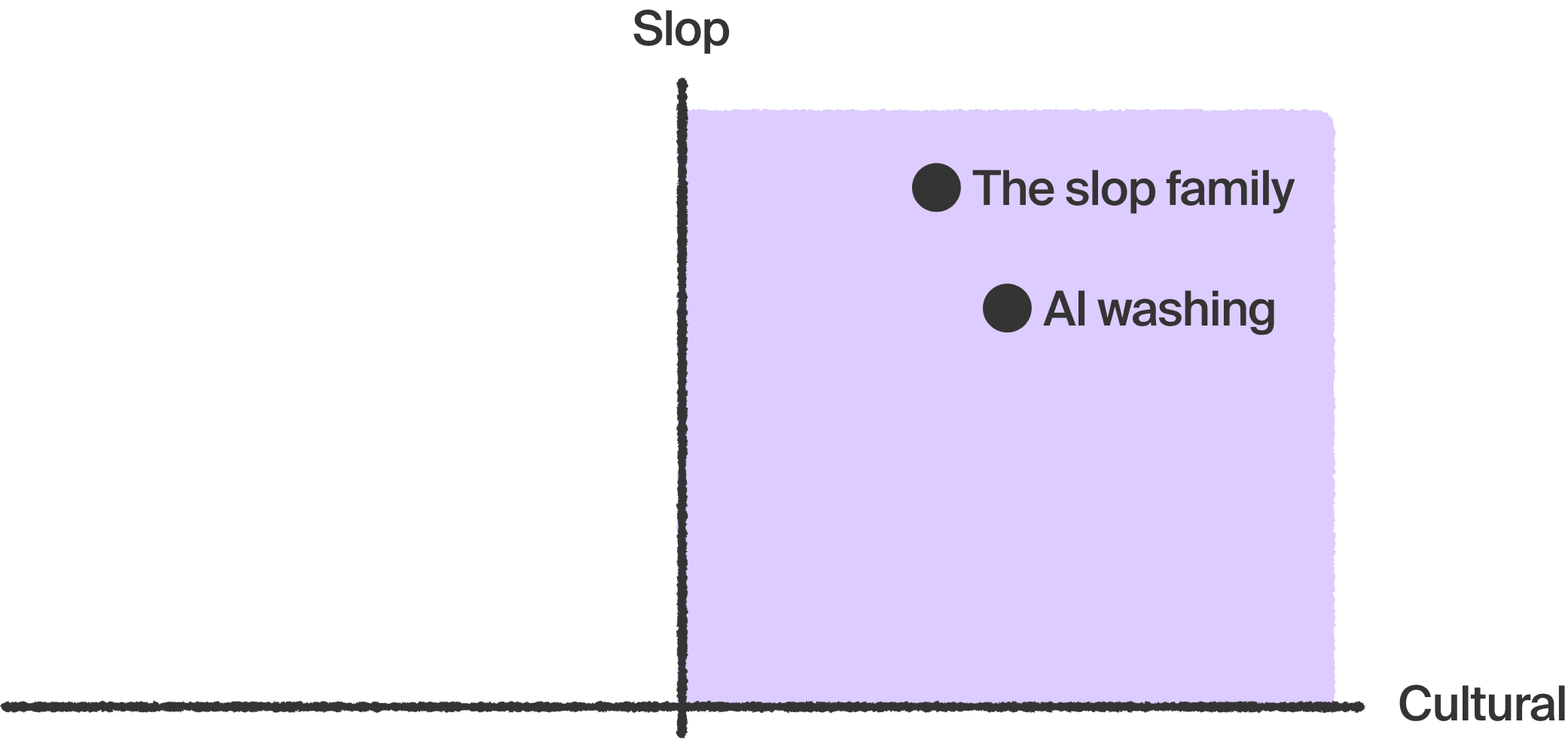
To help you keep up, we mapped the buzzwords you’re most likely to hear in 2026. Each term’s spot on the map shows whether it’s grounded in real tech, shaping workflows, or mostly just playful hype.
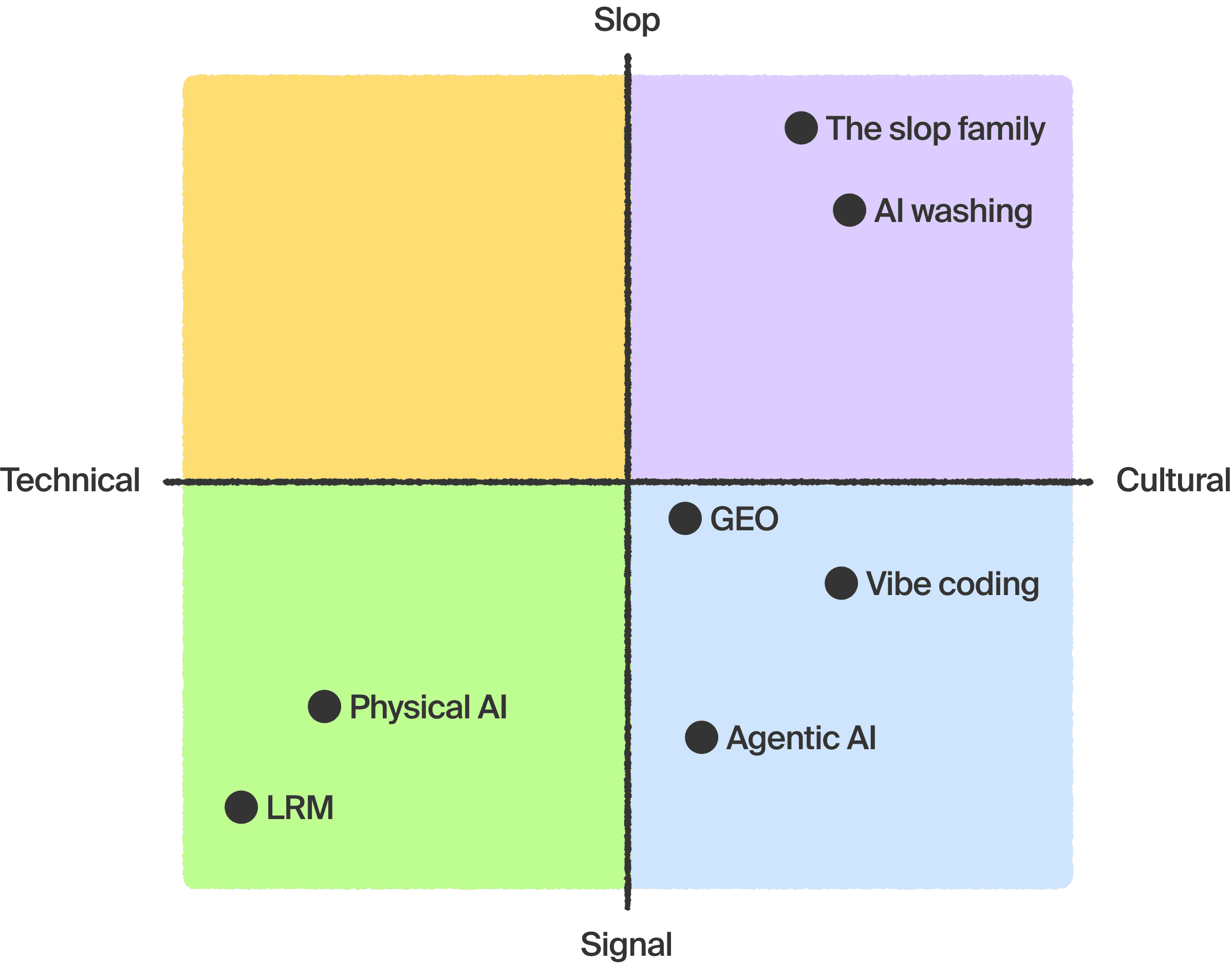
2026 AI Buzzword map
Keep reading to see what these buzzwords mean and why they might matter this year.
Where the signal is strongest
Many AI concepts are firmly rooted in real systems. They’re technical, grounded, and signal meaningful developments in the tech world. These are the terms you’ll want to pay attention to if you’re trying to keep up with AI this year.
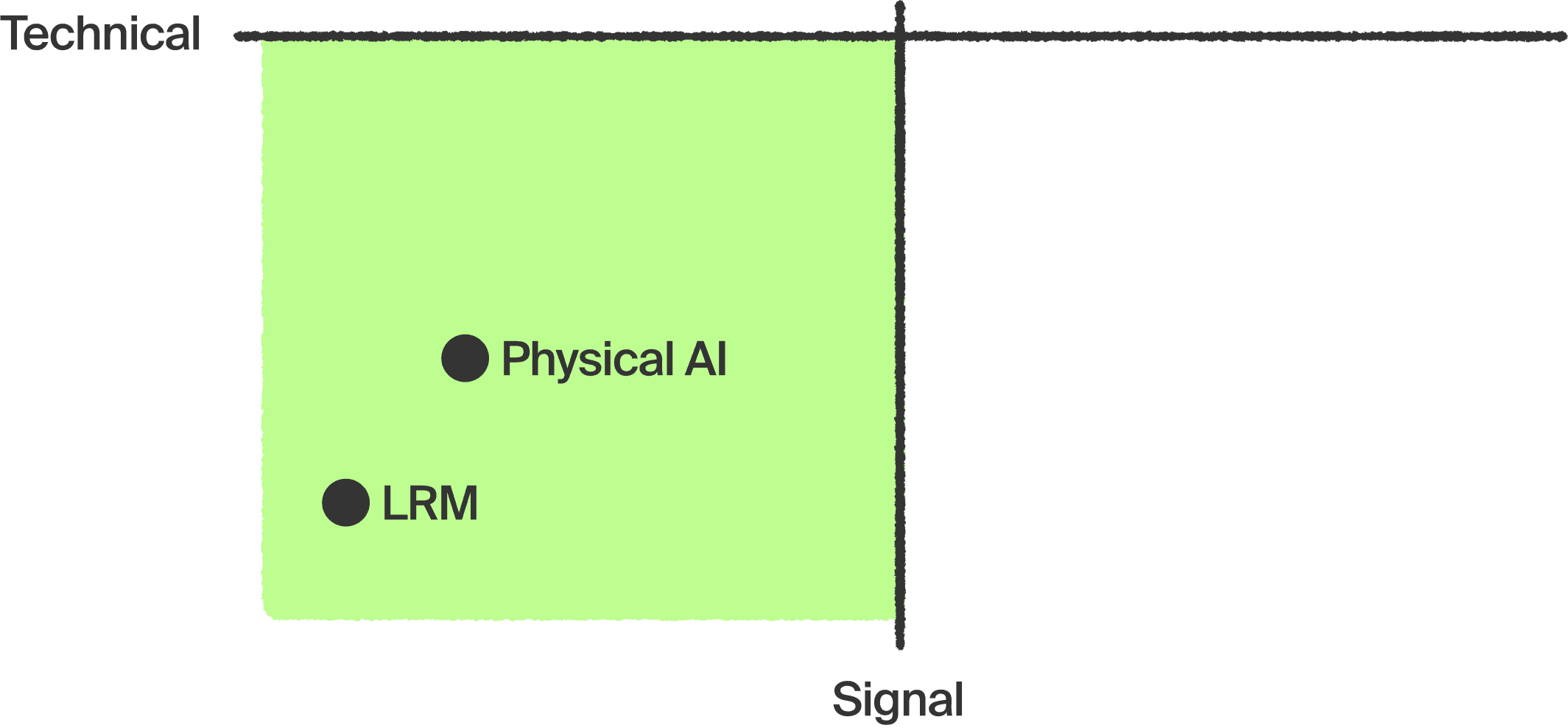
Large Reasoning Models (LRM)
LRMs are exactly what they sound like: AI systems designed to reason through problems step by step, rather than just predicting the next word. Think of them as AI that can actually “think” rather than just autocomplete.
You’re most likely to see LRMs in:
Advanced research papers and technical demos
Cutting-edge AI labs exploring reasoning, planning, and problem-solving
Applications like multi-step question answering or code generation
LRMs are pushing AI beyond pattern-matching toward reasoning. That means smarter assistants, more capable research agents, and more sophisticated automation in 2026 and beyond.
Want to learn more? Check out these reads:
For background information: What are large reasoning models?
For an interesting deep dive: The illusion of thinking
For a fun read: Artificial intelligence learns to reason
Physical AI
Physical AI is pulling intelligence out of the screen and unleashing it into the real world. Think robots, drones, and any device powered by AI that can sense, touch, move, and interact.
You’ll find it in:
Robotics labs and autonomous warehouses
Drones for delivery or inspection
Smart devices and automated manufacturing
Physical AI is bridging the gap between virtual intelligence and real-world application. In 2026, we’ll likely see it continue to make tasks like logistics, automation, and scientific research more capable and flexible.
Want to learn more? Check out these reads:
For background information: What is physical AI?
For an interesting deep dive: AI beyond the digital world
For a fun read: The robots are here and walking among us
Where AI is being used now
This is the sweet spot where AI starts to interact with human workflows and culture. These terms are meaningful but the definitions are starting to stretch as they move from research labs to everyday practice.
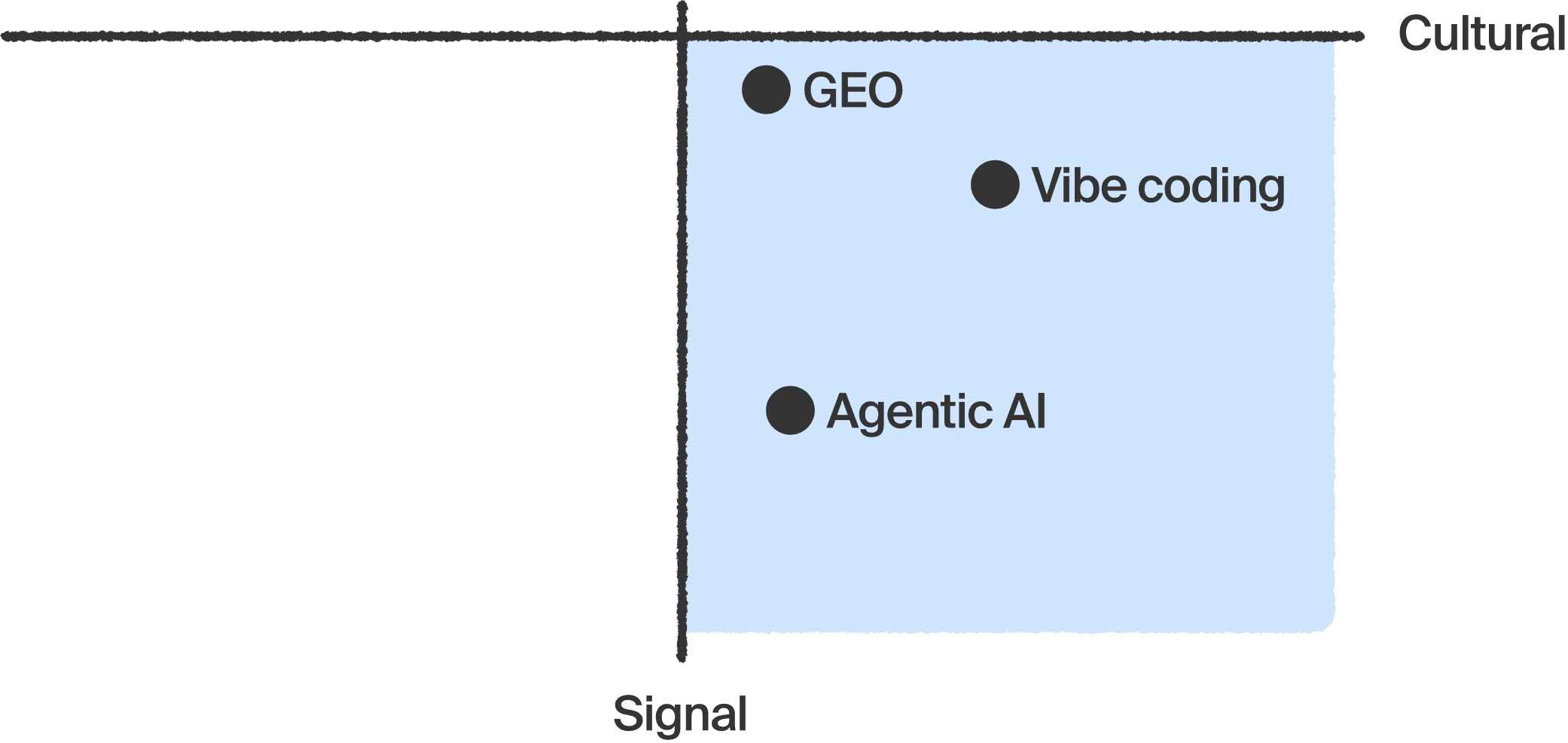
Agentic
Agentic AI refers to systems that can plan, decide, and act with some degree of autonomy, often without constant human input. This isn’t AI taking over the world, but AI helping handle tasks and make decisions in ways that feel proactive.
You’re seeing it in:
Experimental autonomous agents in labs
AI assistants that suggest next steps
Workflow automation tools that act without direct instructions
Agentic AI is shaping how teams interact with systems, creating opportunities for more productive collaboration while also raising important questions about boundaries and oversight.
Want to learn more? Check out these reads:
For background information: AI agents are taking over
For an interesting deep dive: Deciphering the alphabet soup of agentic AI protocols
For a fun read: What is the “social media for AI” Moltbook?
Generative Engine Optimization (GEO)
GEO is essentially search engine optimization (SEO) for AI outputs. It’s about optimizing GenAI systems, from text to images to code, to make outputs more useful and relevant. Humans are quickly moving from traditional searches to AI summaries, making this a term we’re seeing more and more often.
You’ll find GEO in:
AI content platforms
Marketing and design workflows
Developer experimentation with AI-assisted outputs
Blogs and LinkedIn posts are already exploring GEO strategies for AI-generated content. The good news? It’s giving teams more control over AI outputs, making content creation, design, and research workflows more efficient.
Want to learn more? Check out these reads:
For background information: What is GEO?
For an interesting deep dive: A comprehensive guide to GEO
For a fun read: Forget SEO. Welcome to the world of GEO
Vibe coding
Vibe coding is about building with AI in a flexible, iterative way — letting the system suggest solutions while humans adjust and guide the output. It’s a collaborative, creative workflow rather than a rigid plan.
You’ll see it in:
Rapid prototyping sessions
AI-assisted development projects
Teams experimenting with Copilot-style tools
Vibe coding continues to make AI-assisted workflows more dynamic, human-friendly, and experimental. It’s a playful term, but it represents real practices teams are using today.
Want to learn more? Check out these reads:
For background information: What is vibe coding?
For an interesting deep dive: A structured workflow for vibe coding
For a fun read: Cracking the code of vibe coding
Where language outweighs substance
Some AI terms live in the weird liminal space where they hint at real technology, but stop short of saying anything concrete.They reflect the human side of AI: how we notice, joke about, and react to hype.
The slop family
The slop family includes terms like workslop, promptslop, and deckslop — ways of describing AI-generated outputs that lack depth or usefulness. These terms are semi-sarcastic and are mostly used to talk about AI quirks in a shared language.
You’ll see them in:
Slack or Teams chats
Internal project humor
Social media commentary about AI outputs
These buzzwords help teams discuss AI limitations without judgment, while capturing a cultural awareness of overused or low-effort outputs.
Want to learn more? Check out these reads:
For background information: Is “workslop” the word of 2026?
For an interesting deep dive: How I learned to stop worrying and love AI slop
For a fun read: AI slop is transforming social media
AI washing
Remember how “green washing” dominated headlines in the 2010s? AI washing follows the same recipe: products, projects, or features are labeled as AI-powered to sound impressive without actually doing anything novel. It’s a cultural critique more than a technical term.
You’ll see it in:
Marketing materials and press releases
Pitch decks
Product launches claiming AI capabilities
AI washing reminds us to look beyond labels, evaluate claims critically, and ask whether a product truly leverages AI in meaningful ways.
Want to learn more? Check out these reads:
For background information: Spotting AI washing
For an interesting deep dive: The legal risks of AI washing
For a fun read: The big AI washing dilemma
What’s coming in 2027
AI buzzwords don’t just appear overnight. They evolve as technology, culture, and workflows change. Here’s a peek at what could be on the horizon next year:
More “agentic” experiments: The word “agentic” might gain new layers as these tools and systems mature. Agentic robots, anyone?
Physical AI meets everyday life: As robots, smart devices, and sensor-driven AI become more accessible, we might see terms emerge to describe AI in our homes, offices, and public spaces.
New workflow shorthand: Expect more playful terms that describe how people actually work with AI. They’ll likely combine humor and utility, like a language of collaboration baked into AI usage.
Cultural commentary evolves: Terms like “AI washing” and the slop family will inspire new ways to critique, joke, or call out hype. Maybe we’ll see a 2027 equivalent — a new meme-ready term for overhyped AI.
The fun part about AI buzzwords is that the more the technology changes, the more creative our language gets. Some terms will drift into slop, some will stick, and some entirely new ones will pop up to describe the next wave of AI evolution.
2026 AI Buzzword map
Keep reading to see what these buzzwords mean and why they might matter this year.
Where the signal is strongest
Many AI concepts are firmly rooted in real systems. They’re technical, grounded, and signal meaningful developments in the tech world. These are the terms you’ll want to pay attention to if you’re trying to keep up with AI this year.
Large Reasoning Models (LRM)
LRMs are exactly what they sound like: AI systems designed to reason through problems step by step, rather than just predicting the next word. Think of them as AI that can actually “think” rather than just autocomplete.
You’re most likely to see LRMs in:
Advanced research papers and technical demos
Cutting-edge AI labs exploring reasoning, planning, and problem-solving
Applications like multi-step question answering or code generation
LRMs are pushing AI beyond pattern-matching toward reasoning. That means smarter assistants, more capable research agents, and more sophisticated automation in 2026 and beyond.
Want to learn more? Check out these reads:
For background information: What are large reasoning models?
For an interesting deep dive: The illusion of thinking
For a fun read: Artificial intelligence learns to reason
Physical AI
Physical AI is pulling intelligence out of the screen and unleashing it into the real world. Think robots, drones, and any device powered by AI that can sense, touch, move, and interact.
You’ll find it in:
Robotics labs and autonomous warehouses
Drones for delivery or inspection
Smart devices and automated manufacturing
Physical AI is bridging the gap between virtual intelligence and real-world application. In 2026, we’ll likely see it continue to make tasks like logistics, automation, and scientific research more capable and flexible.
Want to learn more? Check out these reads:
For background information: What is physical AI?
For an interesting deep dive: AI beyond the digital world
For a fun read: The robots are here and walking among us
Where AI is being used now
This is the sweet spot where AI starts to interact with human workflows and culture. These terms are meaningful but the definitions are starting to stretch as they move from research labs to everyday practice.
Agentic
Agentic AI refers to systems that can plan, decide, and act with some degree of autonomy, often without constant human input. This isn’t AI taking over the world, but AI helping handle tasks and make decisions in ways that feel proactive.
You’re seeing it in:
Experimental autonomous agents in labs
AI assistants that suggest next steps
Workflow automation tools that act without direct instructions
Agentic AI is shaping how teams interact with systems, creating opportunities for more productive collaboration while also raising important questions about boundaries and oversight.
Want to learn more? Check out these reads:
For background information: AI agents are taking over
For an interesting deep dive: Deciphering the alphabet soup of agentic AI protocols
For a fun read: What is the “social media for AI” Moltbook?
Generative Engine Optimization (GEO)
GEO is essentially search engine optimization (SEO) for AI outputs. It’s about optimizing GenAI systems, from text to images to code, to make outputs more useful and relevant. Humans are quickly moving from traditional searches to AI summaries, making this a term we’re seeing more and more often.
You’ll find GEO in:
AI content platforms
Marketing and design workflows
Developer experimentation with AI-assisted outputs
Blogs and LinkedIn posts are already exploring GEO strategies for AI-generated content. The good news? It’s giving teams more control over AI outputs, making content creation, design, and research workflows more efficient.
Want to learn more? Check out these reads:
For background information: What is GEO?
For an interesting deep dive: A comprehensive guide to GEO
For a fun read: Forget SEO. Welcome to the world of GEO
Vibe coding
Vibe coding is about building with AI in a flexible, iterative way — letting the system suggest solutions while humans adjust and guide the output. It’s a collaborative, creative workflow rather than a rigid plan.
You’ll see it in:
Rapid prototyping sessions
AI-assisted development projects
Teams experimenting with Copilot-style tools
Vibe coding continues to make AI-assisted workflows more dynamic, human-friendly, and experimental. It’s a playful term, but it represents real practices teams are using today.
Want to learn more? Check out these reads:
For background information: What is vibe coding?
For an interesting deep dive: A structured workflow for vibe coding
For a fun read: Cracking the code of vibe coding
Where language outweighs substance
Some AI terms live in the weird liminal space where they hint at real technology, but stop short of saying anything concrete.They reflect the human side of AI: how we notice, joke about, and react to hype.
The slop family
The slop family includes terms like workslop, promptslop, and deckslop — ways of describing AI-generated outputs that lack depth or usefulness. These terms are semi-sarcastic and are mostly used to talk about AI quirks in a shared language.
You’ll see them in:
Slack or Teams chats
Internal project humor
Social media commentary about AI outputs
These buzzwords help teams discuss AI limitations without judgment, while capturing a cultural awareness of overused or low-effort outputs.
Want to learn more? Check out these reads:
For background information: Is “workslop” the word of 2026?
For an interesting deep dive: How I learned to stop worrying and love AI slop
For a fun read: AI slop is transforming social media
AI washing
Remember how “green washing” dominated headlines in the 2010s? AI washing follows the same recipe: products, projects, or features are labeled as AI-powered to sound impressive without actually doing anything novel. It’s a cultural critique more than a technical term.
You’ll see it in:
Marketing materials and press releases
Pitch decks
Product launches claiming AI capabilities
AI washing reminds us to look beyond labels, evaluate claims critically, and ask whether a product truly leverages AI in meaningful ways.
Want to learn more? Check out these reads:
For background information: Spotting AI washing
For an interesting deep dive: The legal risks of AI washing
For a fun read: The big AI washing dilemma
What’s coming in 2027
AI buzzwords don’t just appear overnight. They evolve as technology, culture, and workflows change. Here’s a peek at what could be on the horizon next year:
More “agentic” experiments: The word “agentic” might gain new layers as these tools and systems mature. Agentic robots, anyone?
Physical AI meets everyday life: As robots, smart devices, and sensor-driven AI become more accessible, we might see terms emerge to describe AI in our homes, offices, and public spaces.
New workflow shorthand: Expect more playful terms that describe how people actually work with AI. They’ll likely combine humor and utility, like a language of collaboration baked into AI usage.
Cultural commentary evolves: Terms like “AI washing” and the slop family will inspire new ways to critique, joke, or call out hype. Maybe we’ll see a 2027 equivalent — a new meme-ready term for overhyped AI.
The fun part about AI buzzwords is that the more the technology changes, the more creative our language gets. Some terms will drift into slop, some will stick, and some entirely new ones will pop up to describe the next wave of AI evolution.
Article by

Mindrift Team


