Ways to earn
Article by
Mindrift Team

What’s an AI agent?
AI agents are language models that take multi-step actions to complete a goal. The usefulness of an AI agent depends on its ability to check its own steps as it moves through the process, ensuring that the end result fulfills the goal accurately.
Picture an AI agent that’s given a simple task: book a flight from Toronto to Athens on July 23. Twenty minutes later it comes back having searched the wrong dates, decided that was fine, and confidently booked your flight for July 25.
It went through all the correct steps and processes but the end goal wasn’t fulfilled accurately. The only way to catch it? Watch every step along the way. That’s the basis of training AI agents. Not "was the answer good?" but "was every decision that led to it good?"
This guide covers what AI agent training is, how agentic training differs from regular AI training, what makes someone good at it, and how to actually get better once you're doing it.
The basics of AI agents
A few years ago, training an AI model usually meant something simpler: read a prompt, read a response, decide if the response was good, maybe rewrite it, move on. Agentic training is different. You're judging a chain of decisions, sometimes dozens of them, where a system plans an approach, uses tools, checks its own work, and adjusts along the way.
Inside the agentic loop
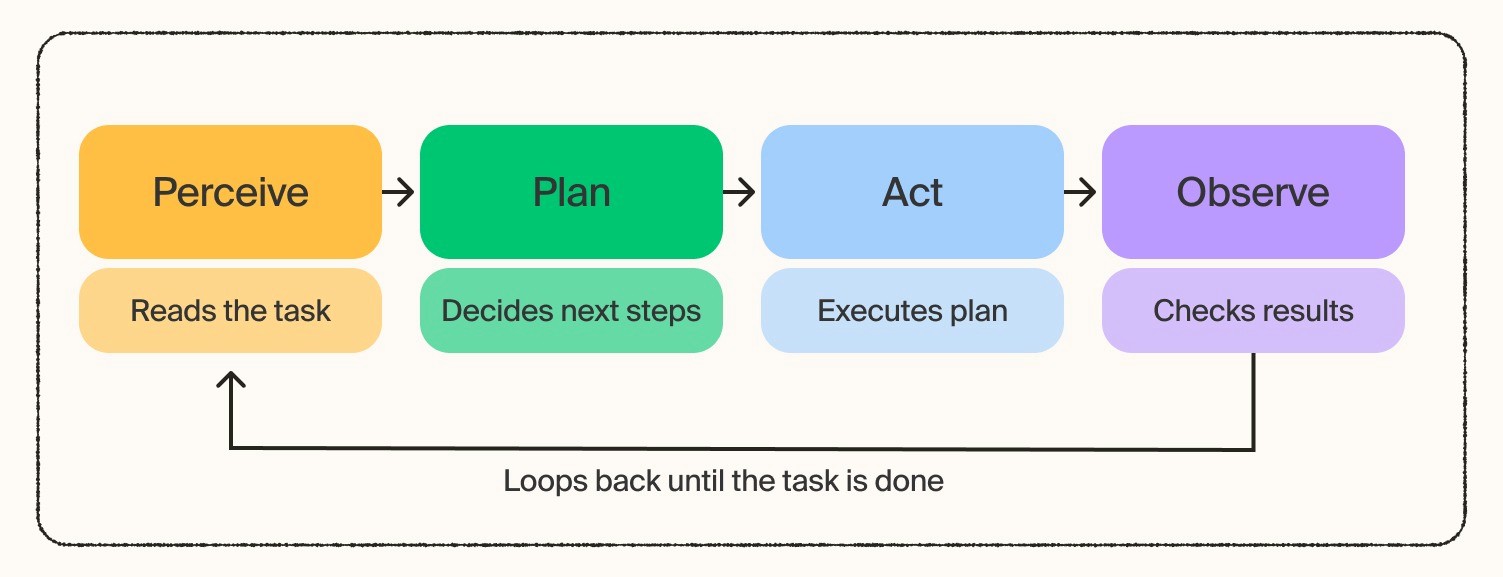
The basic agentic loop looks like this: the agent perceives the task and its environment, reasons about what to do, takes an action, observes what happened, and repeats, adjusting its plan as new information comes in. That loop can run for a few steps or a few hundred, depending on the task.
AI agents have been a hot topic over the past few years and people have wildly differing opinions on their potential. But agents didn't really become practical until a few things matured at once:
Reasoning in base models got good enough to plan multi-step tasks
Tool-use (or function calling) became reliable enough to trust
Context windows got long enough to hold a whole working session
The software scaffolding around models (the orchestration layer) got better at managing all of it
Not at all AI agents are the same and you'll often run into three different types:
Single-task agents do one thing well, like writing and debugging code
Multi-step autonomous agents handle longer, more open-ended work, like researching a topic or executing a multi-part workflow
Multi-agent systems split a task across several agents that coordinate with each other
In practice, agents show up most in coding, customer support, research, data analysis, and workflow automation — places where "do the task," not just "describe the task," has real value.
How agentic training differs from AI training
This is the part that surprises people coming from traditional AI training. Traditional training largely optimizes for a single response given a prompt. Think: is this reply accurate, helpful, well-written?
Agentic training has to account for sequences of decisions, where an early choice shapes everything downstream. A model that picks the wrong tool in step two might still produce a plausible-looking answer in step ten but the path it took to get there was wrong. A good trainer knows to look for and catch this misstep.
Dimension | Traditional Al training | Al agent training |
|---|---|---|
Evaluation | Single response | Full trajectory |
Main question | Is this answer good? | Was every decision good? |
Feedback timing | Immediate | Often delayed to the end |
Data format | Prompt-response pairs | Trajectories with tool calls |
Common failures | Factual errors, tone issues | Infinite loops, tool use issues |
Cause identification | No need (single turn) | Find step that cause failure |
That changes what output scoring means when it comes to training. You're not just asking "is this answer good?" You're asking:
Did it choose the right tool for the job?
Did it know when to stop, or did it keep going past the point of usefulness?
When something went wrong mid-task, did it notice and recover, or plow ahead?
Did it ask a clarifying question when the task was genuinely ambiguous, instead of guessing?
Feedback also tends to be a bit sparser and more delayed. A multi-step task might only reveal success or failure at the very end, which means a big part of it is figuring out which step actually caused a downstream failure, rather than just flagging that the final output was wrong.
Agent failure modes can include hallucinated tool use, infinite loops, overconfident wrong actions, or not recognizing that a task is already complete. Evaluation has to account for the entire process, not just the outcome. An agent that stumbles into the right answer through a reckless or inefficient path isn't actually doing the job well.
What good agentic trainers do differently
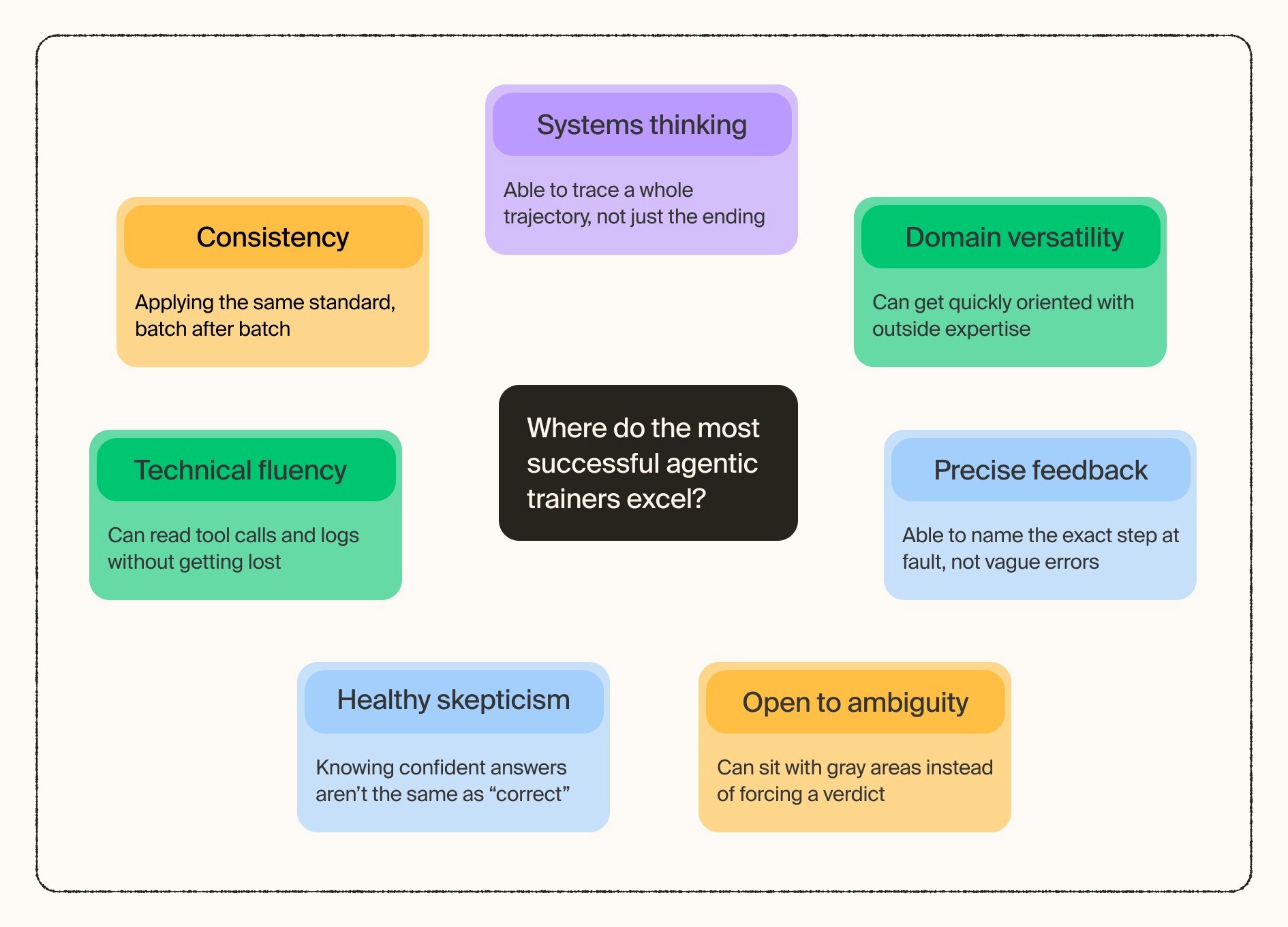
What makes a good AI trainer vs. a good agentic trainer? A lot of the same hard and soft skills but they show up differently, and sometimes matter more, in agent training.
Systems thinking
You need to be able to trace an entire trajectory and spot exactly where it went sideways, not just react to the final output. That means holding the whole sequence in your head at once — noticing, for instance, that a wrong answer at step nine was actually caused by a bad assumption the agent made at step two and never revisited.
Domain versatility (or at least comfort learning fast)
Agent tasks span coding, research, customer support, and more. You won't be an expert in every domain you evaluate, so being able to get oriented quickly matters a lot. A trainer evaluating a legal-research agent one day and a SQL debugging agent the next needs to learn just enough of each domain's shape to know what a competent move looks like, without spending an hour becoming a specialist.
Precision in feedback
"This is bad" doesn't help improve the agent model. Good trainers point to the exact step where things broke and explain specifically what should have happened instead. Think of it as the difference between feedback like "the agent got confused" and "the agent misread the second API response as a success and never checked the returned status code."
Patience with ambiguity
A lot of agent behavior lives in gray areas. You might have to ask yourself questions like “was that tool call reasonable given what the agent knew at the time?” Reasonable people can disagree, and good trainers are comfortable sitting with that instead of forcing a clean verdict.
Healthy skepticism
It's easy to rate something as a success because it looks confident and arrives at a plausible-sounding answer. Good trainers resist that pull and check the work — opening the tool output the agent cited, not just trusting the agent's summary of what it found.
Some technical fluency
You don't need to be an engineer or coding expert, but you should be comfortable enough with tool calls, logs, or API outputs that you're not lost reading a trajectory. If a stack trace or a malformed JSON response makes you want to skip ahead to the agent's final summary, that's exactly the part of the trajectory you can't afford to skip.
Consistency
Your judgment needs to hold steady across a session and across days. Rating the same quality of work differently depending on your mood or how many examples you've already seen undermines the whole exercise. And at scale, that inconsistency becomes the errors the model ends up training on.
Article by

Mindrift Team


